Stem Cells and Sexual Wellness: The Biology Behind Cellular Regeneration for Tissue and Function
Sexual function is, at its foundation, a vascular and neurological process. That framing matters at the outset, because it explains both why regenerative biologics have been studied here and why the honest assessment of the evidence has to be handled carefully rather than sold. This article treats the subject the way the audience deserves — clinically and directly, without euphemism, and without pretending the evidence is stronger than it is.
What follows is the biology of how sexual function degrades, how cellular biologics are proposed to interact with the tissue, what the human evidence shows for men and women separately, why hormonal correction frequently belongs in the same conversation, and who is a reasonable candidate. For the broader scientific and regulatory context, the pillar article on stem cells in regenerative medicine covers the field.
The biology of sexual function — and how it degrades
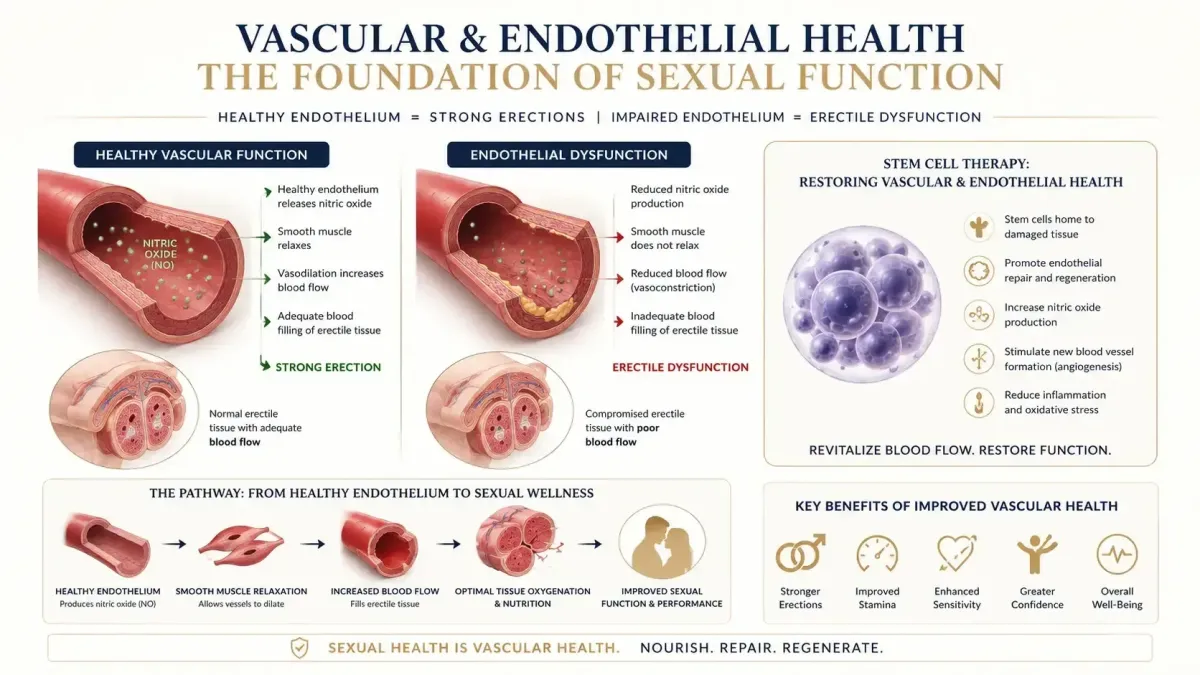
Erectile function in men depends on healthy vascular tissue, blood flow, nerve signaling, and the smooth muscle and endothelial cells lining the penile blood vessels. With age, vascular disease, diabetes, or nerve damage from procedures such as prostatectomy, these systems degrade. Blood flow diminishes, the endothelial lining becomes less responsive, and the tissue loses functional capacity. This is why erectile dysfunction is often an early marker of broader cardiovascular disease.
In women, sexual function similarly depends on vascular supply, nerve signaling, tissue integrity, and vulvovaginal mucosal health — all strongly influenced by hormonal status. Estrogen decline through menopause produces measurable changes: reduced blood flow, thinning and reduced elasticity of the mucosa, decreased lubrication, and the cluster of symptoms termed genitourinary syndrome of menopause. Here too, the issue is substantially one of tissue and vascular health.
Because the substrate is biological tissue in both cases, the theory behind a regenerative approach is coherent: an intervention supporting vascular and tissue health at the cellular level is aimed at the actual mechanism of the problem. But a coherent theory is the starting point of a clinical question, not the answer to it.
How cellular biologics are proposed to interact with the tissue
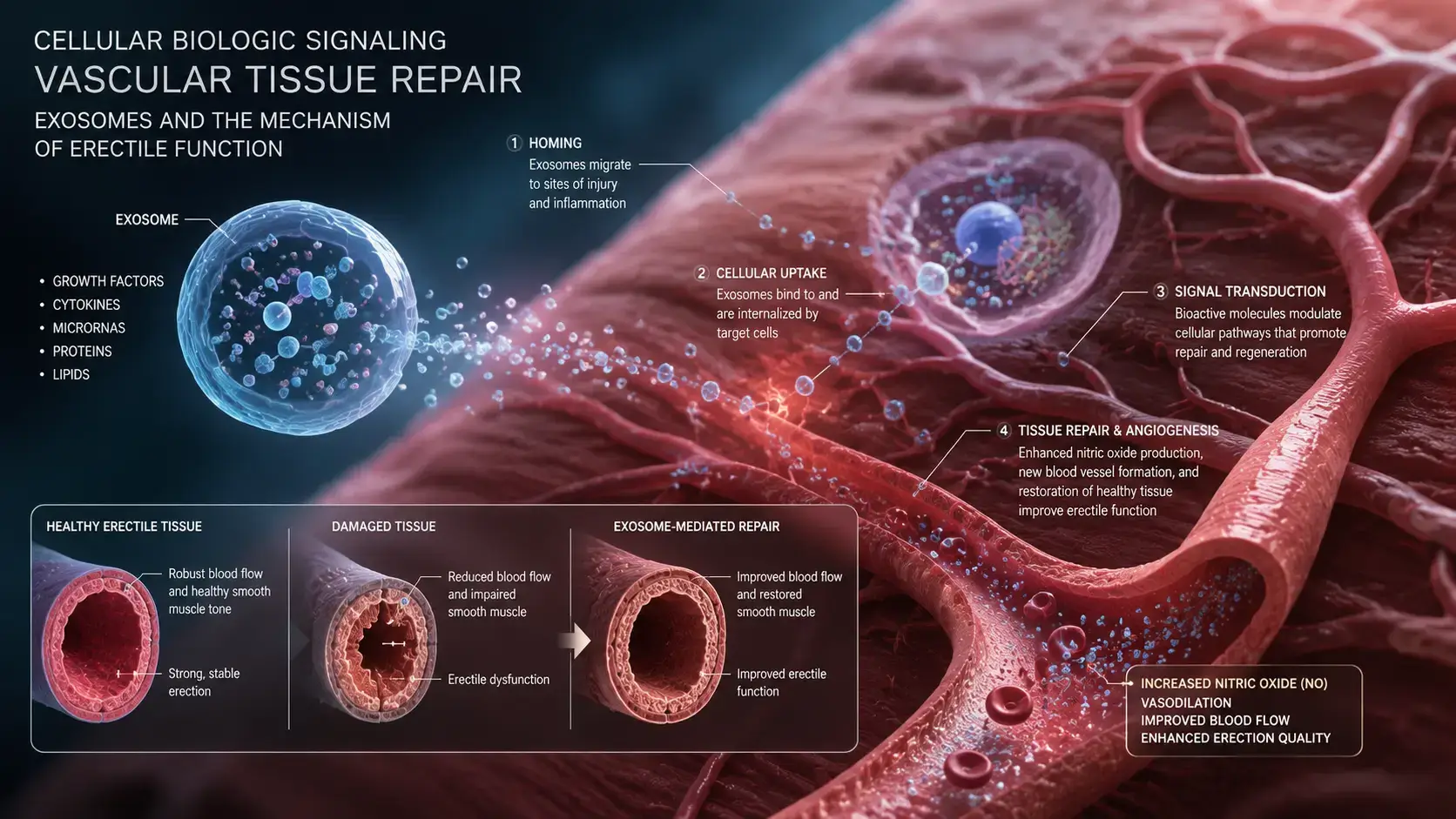
Cellular biologics here — mesenchymal stem cells and their derived products, including exosomes — are proposed to work through the same signaling mechanism that defines them elsewhere. They do not replace tissue directly. They release biologically active molecules that influence the local environment: promoting the formation and health of blood vessels, supporting the endothelial and smooth muscle cells that vascular function depends on, and modulating inflammation and repair in the tissue.
In men, the biologic is typically delivered to the vascular tissue of the penis, aiming to support the endothelial health and blood flow that erectile function requires. In women, the aim is to support the vascular supply and tissue integrity of the vulvovaginal region, often in the context of menopausal tissue change. Related orthobiologic approaches using platelet-rich plasma have been studied in both contexts on a similar rationale.
The mechanism is plausible and consistent with how these biologics behave elsewhere. Whether it produces reliable clinical results in humans is a separate question, answered differently for men and women.
What the evidence shows in men
The male evidence is the more developed of the two, though it remains early. A 2025 systematic review and meta-analysis of stem cell therapy for erectile dysfunction found that most of the human studies reviewed reported improvements in erectile function following intracavernosal stem cell therapy, with statistically significant gains at six months in validated measures including the International Index of Erectile Function and objective measures of penile blood flow.
That is a genuinely encouraging signal, and it should be stated as such. It should also be stated honestly that the same review worked from a small evidence base — roughly eleven human studies, a subset pooled for meta-analysis — and that the field describes the approach as promising but not yet established. The signal points in a favorable direction; the volume and standardization of evidence needed to call it proven are not yet there.
What the evidence shows in women
The female evidence is weaker, and honesty requires saying so plainly rather than extending the men's data to women, where it does not apply. A 2023 systematic review of platelet-rich plasma for female sexual dysfunction concluded there is no clear evidence in the literature that these injections improve female sexual dysfunction, even though individual studies reported improvements on standardized measures.
More pointedly, a recent randomized, placebo-controlled trial of vaginal PRP for sexual function found improvements in desire, arousal, lubrication, and orgasm that were not statistically significant when compared against placebo. This is exactly the result responsible framing must not obscure: a favorable-looking trend that did not hold up against a control. For women, the evidence supports honest caution, not confidence, and any practice presenting these approaches as established for female sexual wellness is moving beyond the data.
Why hormonal correction often belongs in the conversation
In both sexes, but especially in women, sexual function cannot be separated from hormonal status — and this is where a biologic-only conversation often misses the more important variable. In women, the tissue changes of genitourinary syndrome of menopause are driven substantially by estrogen decline, and addressing the hormonal environment is frequently more directly relevant to symptoms than any biologic. In men, testosterone status affects libido, tissue health, and erectile function.
This is why a serious assessment does not begin with a biologic. It begins with the full picture: hormonal evaluation, cardiovascular and metabolic health, medications, and the specific nature of the dysfunction. In many cases, hormonal optimization or management of an underlying vascular or metabolic issue is a more appropriate and better-evidenced starting point than a cellular biologic. An honest program identifies that rather than defaulting to the intervention it happens to offer.
Candidacy and what the assessment covers
Candidacy is established through a thorough clinical assessment, and it matters more here than almost anywhere, precisely because the evidence is early and the alternatives are often better established. The evaluation covers the specific nature and likely cause of the dysfunction, hormonal status, cardiovascular and metabolic health, medications, and prior treatments and their results.
For some, the assessment points toward addressing an underlying hormonal, vascular, or metabolic issue with better-established approaches before any biologic is considered. For others, a biologic may be a reasonable option to discuss, with honest framing of what the evidence supports for their specific situation and sex. The men's and women's programs are addressed respectively at valereregenerative.com/offerings/sexual-health-wellness/mens-sexual-wellness and valereregenerative.com/offerings/sexual-health-wellness/womens-sexual-wellness, and both begin with that assessment rather than a predetermined recommendation.

How the FDA framework applies to sexual health biologics
The regulatory reality is the same here as elsewhere, and worth stating precisely given the sensitivity of the area. The FDA regulates the cellular and exosome biologic products and requires the manufacturing laboratories to be registered and compliant. It does not approve specific protocols for sexual wellness, and there are no FDA-approved stem cell or exosome products for these applications.
When these biologics are used in this context, they are used off-label, sourced from FDA-registered laboratories, and administered under physician supervision. All three conditions hold at once. This is the same off-label structure that governs much of medicine, but the combination of early evidence and a sensitive, heavily marketed area makes compliant sourcing and honest framing especially important. Valere sources exclusively from FDA-registered, compliant laboratories, and is direct about the state of the evidence rather than implying more certainty than exists.
Frequently Asked Questions
Does stem cell therapy work for erectile dysfunction? The human evidence is early but encouraging: most studies to date report improvement, with significant six-month gains in validated measures in a recent meta-analysis. It is not yet a standardized treatment, and should be discussed as still-emerging rather than proven.
Does it work for women's sexual health? The evidence is weaker. A recent randomized trial of PRP found improvements that were not statistically significant versus placebo, and a systematic review found no clear evidence of benefit. Honest caution is warranted, and hormonal and tissue-health approaches are often more relevant.
Should I address hormones first? Frequently, yes. In both sexes, particularly in women navigating menopause, hormonal status is often more directly relevant to sexual function than a biologic, and better established. A proper assessment determines the right starting point.
Is it covered by insurance? No. These are elective, off-label approaches and are private-pay.
The starting point
Cellular biologics for sexual wellness rest on a coherent biological rationale and an evidence base that is early — more developed in men than in women, and in neither case yet established. For the right person, evaluated honestly, they may be a reasonable option to discuss; for many, addressing hormonal, vascular, or metabolic health first is the better-evidenced path. The distinction is a clinical judgment, not a marketing decision.
The way to determine which applies to you is a genuine assessment. Reserve yours atvalereregenerative.com/assessment.