Stem Cells in Regenerative Medicine: What They Are, How They're Used, and What's Actually Legal in 2026
If you have spent any time researching regenerative medicine, you have encountered a specific problem: the gap between what the science actually says and what the market says about it. On one side, an overselling that promises tissue regrown and years reversed. On the other, a dismissiveness that files the entire field under experimental and unproven. Neither is accurate, and the distance between them is where most people trying to make an informed decision get stranded.
This is written for the person who wants the accurate version. What stem cells and their derivatives actually are. How they are being used in clinical regenerative medicine right now. And — the question that generates the most confusion — what is actually legal in the United States in 2026. The goal is not to sell you on anything. It is to give you a picture clear enough to evaluate the field, and any practice operating in it, with the rigor you would apply to any other significant decision.
What stem cells actually are (and what they're not)
The phrase stem cells carries a great deal of cultural baggage, most of it attached to a category that has almost nothing to do with clinical regenerative medicine as it is practiced today. Clearing that up is the necessary first step.
The cells at the center of regenerative medicine are mesenchymal stem cells — MSCs. These are adult cells, found in bone marrow, adipose tissue, umbilical cord tissue, and other sources. They are not embryonic. The public conversation about stem cells has historically been dominated by embryonic stem cells and the ethical debates surrounding them, and this is the single largest source of misconception people bring to the subject. The MSCs used in regenerative medicine are a different category entirely, drawn from adult tissue, and the ethical questions attached to embryonic cells do not apply to them.
What makes MSCs interesting clinically is not what most people assume. The intuitive model — that these cells are injected into damaged tissue, where they transform into new cartilage or tendon and physically rebuild the structure — is largely not how the current science understands their function. The research points to a different and more subtle mechanism.
How they signal repair rather than replacing tissue
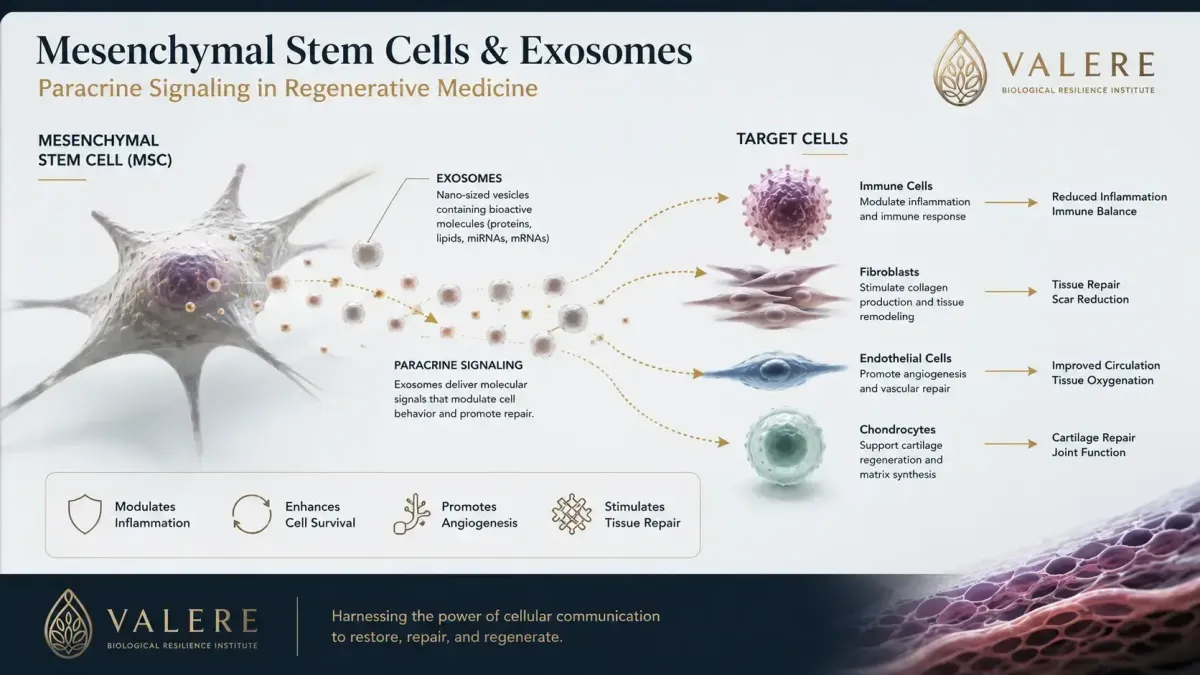
MSCs exert most of their effect through what is called paracrine signaling — the release of biologically active molecules that influence the behavior of the surrounding tissue. Rather than becoming new tissue themselves, they function more like signaling agents, secreting growth factors, cytokines, and other compounds that modulate inflammation, influence the local cellular environment, and support the tissue's own repair processes.
A great deal of that signaling activity is carried by exosomes — nanoscale vesicles, typically under 150 nanometers, that cells release to communicate with one another. They are packets of biological instruction, carrying proteins and genetic material such as microRNA between cells. In the regenerative context, MSC-derived exosomes have become a significant research area precisely because they appear to carry much of the signaling activity that gives the parent cells their effect, without requiring the living cells themselves.
This distinction matters for honest expectations. A field built on cells that signal repair is a different proposition from one built on cells that rebuild structure directly. The mechanism is real and biologically active. It is also not magic, and it does not regrow a joint to its condition at 25. Any claim that suggests otherwise has left the evidence behind.

How stem cells and exosomes are used in clinical regenerative medicine today
In current clinical practice, MSC-derived and exosome-based biologics are applied across several categories. What follows is a factual overview of where these approaches are being used — not a recommendation, and not a claim that any is established standard of care. The evidence base varies considerably across these applications, a point addressed directly further down.
In joint and musculoskeletal medicine, biologic approaches support the tissue environment in degenerative joint conditions and certain soft-tissue injuries. This is the most researched application, where the clinical literature is most developed. The dedicated article on stem cells for joint pain covers the mechanism and candidacy in depth, connected to the program at valereregenerative.com/offerings/joint-renewal-mobility-longevity.
In aesthetic medicine, exosome-based biologics support the skin's own collagen production and cellular renewal — covered in the article on stem cells and skin rejuvenation, connected to valereregenerative.com/offerings/skin-vitality-dermal-renewal. In hair restoration, exosome-derived biologics are applied to influence the follicular environment, addressed in the article on stem cells for hair loss and the program at valereregenerative.com/offerings/hair-rejuvenation-follicular-health.
In sexual wellness, cellular biologics support vascular and tissue function, covered in the article on stem cells and sexual wellness and the men's and women's programs under valereregenerative.com/offerings/sexual-health-wellness. And in systemic applications, exosome-based biologics are administered intravenously, often alongside compounds such as NAD+ — the application requiring the most precise framing, addressed in the article on IV cellular infusion and the program at valereregenerative.com/offerings/iv-therapy-cellular-infusion.
The legal and regulatory reality — what the FDA actually governs
This is the section where most public information about stem cells is either wrong or deliberately vague, so it is worth being precise. The confusion usually starts with a single misunderstood question: are these therapies FDA approved? The honest answer requires understanding what the FDA actually regulates in this space, because the yes-or-no framing does not map onto how the regulation works.
The FDA regulates the biological products themselves —human cells, tissues, and cellular and tissue-based products, which the agency refers to as HCT/Ps — under 21 CFR Part 1271. The laboratories that manufacture these products are required to register with the FDA and to follow specific standards designed to screen for communicable disease and ensure the products are handled to a consistent standard. This registration and compliance framework is real, it is enforced, and it is the foundation of what makes a biologic legitimate. Sourcing from an FDA-registered, compliant laboratory is not a marketing line. It is the baseline requirement, and at Valere it is non-negotiable.
What the FDA does not do is approve individual clinical protocols the way it approves a specific drug for a specific indication. This is the distinction that the yes-or-no question misses. And it is not unique to regenerative medicine — it describes a large portion of how medicine is practiced.
What "off-label" means and why it is standard practice
When the FDA approves a drug, it approves it for a particular use. Physicians then routinely apply that same drug, using clinical judgment, to other conditions where the evidence and their experience support it. This is called off-label use, and it is legal, common, and entirely standard across medicine. A substantial share of prescriptions written every day are off-label. The practice reflects a basic division of authority: the FDA governs products, and licensed physicians exercise clinical judgment about how to apply them to individual patients.
Biologic protocols using MSC-derived and exosome-based products occupy this same territory. When these preparations are used in a clinical program, they are used off-label — administered under physician supervision, sourced from FDA-registered laboratories, applied on the basis of clinical judgment. All three conditions are true simultaneously, and stating them plainly is part of how an honest practice operates. A practice that implies its specific protocol carries FDA approval is misrepresenting the regulatory reality. A practice that acknowledges off-label use, compliant sourcing, and physician supervision is describing it accurately.
It is also worth noting that the regulatory framework contains real distinctions that separate compliant practice from non-compliant practice — the degree to which a product is manipulated during processing, and whether its use is consistent with its biological function, both bear on how it is regulated. These are not details a serious practice treats casually. They are the difference between operating inside the framework and operating outside it.
Why "only available in Mexico" is outdated
A persistent piece of folklore holds that legitimate stem cell therapy is only available outside the United States. This is a holdover from an earlier period and no longer reflects reality. Biologic programs using compliantly sourced, FDA-registered products administered under physician supervision operate within the United States. The offshore framing often served practices that were avoiding the compliance framework rather than working within it. The relevant question is not which country a therapy is offered in. It is whether the products are sourced from FDA-registered laboratories and administered under genuine physician supervision.
The hesitations worth taking seriously — and the ones that aren't
A discerning person approaching this field arrives with hesitations, and they deserve to be addressed honestly rather than dismissed. Some are well-founded. Some are outdated. Distinguishing between them is the whole task.
"It's experimental." This was a fair characterization a decade ago. The field has matured considerably since, particularly in the most-researched applications. But maturation is not the same as settled, and honesty requires holding both facts at once: the science has advanced meaningfully, and it is still an evolving field rather than a closed one. Anyone who tells you the questions are all answered is overstating. Anyone who tells you nothing has progressed is understating.
"It's not FDA approved." Addressed above — this reflects a misunderstanding of what FDA approval governs. The products are regulated and the laboratories are registered; the protocols are applied off-label under physician judgment, as across much of medicine. The concern is based on a real fact, framed incorrectly.
"The results aren't proven." This deserves to be taken seriously, because the evidence genuinely varies by application. In joint and musculoskeletal medicine, the clinical literature is relatively developed — a narrative review of MSCs in osteoarthritis described clinical results as promising while noting that a lack of standardization in how cells are isolated has kept them out of formal treatment guidelines. That is an honest summary: encouraging, not conclusive. Across the broader field, a review of MSC-derived extracellular vesicle clinical trials from 2014 to 2024 found the approach genuinely emerging, while flagging that the absence of standardized protocols still limits clinical translation. The correct posture is neither dismissal nor overstatement — a clear-eyed reading of an evidence base that supports cautious, physician-guided application while more definitive work continues.
"It's only for wealthy people." This one is worth acknowledging plainly rather than deflecting. These programs are largely private-pay, for reasons addressed in the FAQ below, and that is a real limitation on access. Being honest about the private-pay reality is more respectful than pretending otherwise.
What a physician-guided stem cell program actually looks like
The difference between a credible biologic program and a questionable one is not primarily the biologic. It is everything around it — the clinical judgment applied before anything is administered, and the honesty of the framing throughout.
At Valere, a biologic program begins with an assessment, not a recommendation. Before any biologic is considered, the physician establishes the clinical picture: the specifics of the condition, the relevant diagnostics, the Valerian's history and goals, and an honest evaluation of whether a biologic approach is appropriate at all. For some, the assessment concludes that a different approach fits better, and it says so. A program that recommends the same biologic to everyone is not exercising clinical judgment. It is running a sales process.
From that assessment, if a biologic program is appropriate, it is built around the specific clinical picture — with the products sourced from FDA-registered, compliant laboratories, administered under physician supervision, and framed with honest expectations about what the evidence supports and what it does not. The full model, from assessment through the arc of care, is outlined at valereregenerative.com/how-it-works, and the practice's approach and standards are described at valereregenerative.com/about-us.
That combination — genuine assessment, compliant sourcing, physician supervision, and honest framing — is what separates a legitimate regenerative program from the overselling that has given this field its credibility problem. It is also the standard a discerning person should require before considering any of this.

Frequently Asked Questions
Are stem cells legal in the United States? Yes, with an important clarification. Biologic products derived from human cells and tissues are regulated by the FDA, and the laboratories that manufacture them must be FDA-registered and compliant with the standards under 21 CFR Part 1271. When these products are used in a clinical program, they are administered under physician supervision and applied off-label, which is legal and standard across medicine. What is not legitimate is the use of non-compliantly sourced products or claims that a specific protocol carries FDA approval it does not have.
What is the difference between stem cells and exosomes? Mesenchymal stem cells are adult cells that exert much of their effect by signaling to surrounding tissue rather than by replacing it. Exosomes are the nanoscale vesicles that carry much of that signaling activity — the messages, rather than the cells that send them. Exosome-based biologics aim to deliver that signaling activity directly. Both are used in regenerative medicine, and the appropriate application depends on the clinical picture.
How do I know if I'm a candidate? Candidacy is established through a clinical assessment, not from a description of symptoms or a general interest in the field. The physician evaluates the specific condition, the relevant diagnostics, your history and goals, and whether a biologic approach is appropriate for your situation. Some people are better served by a different approach, and the assessment is where that is determined honestly.
Are these treatments covered by insurance? Generally, no. Because biologic protocols are applied off-label and are considered elective rather than established standard of care, they are typically not covered by insurance and are private-pay. This is a real consideration, and it is addressed directly rather than obscured.
How long do results last? This varies by application, by the individual, and by the specific clinical picture, and no honest answer can promise a fixed duration. The biological processes these approaches support are real but not permanent, and many programs involve a maintenance component over time. Any source that guarantees a specific result lasting a specific length of time has moved beyond what the evidence supports.
The starting point
Stem cells in regenerative medicine are neither the miracle the overselling suggests nor the fiction the dismissiveness implies. They are a real, biologically active, evolving category of care — most useful to the person who approaches them with clear eyes, honest expectations, and a practice willing to tell them the truth about what the evidence does and does not support.
If you want to understand what a physician-guided biologic program looks like for your specific situation — evaluated honestly, sourced compliantly, and framed without overstatement — the starting point is the assessment. Reserve yours at valereregenerative.com/assessment.