Stem Cells for Joint Pain: How MSC-Based Biologics Support Structural Renewal Without Surgery
If you have joint pain that has outlasted the conventional playbook — the anti-inflammatories, the physical therapy, the cortisone that works for a while and then does not — you have probably started reading about stem cells for joint pain. And you have probably found the problem that shadows this field: the claims run from miraculous to dismissive, with little in between that treats you as someone capable of evaluating evidence.
This is the in-between version. What MSC-based biologics actually do in a joint. How the approach compares to surgery, honestly. Who is a reasonable candidate and who is not. And what the current evidence supports — including where it is genuinely mixed. For the broader scientific and legal context, the pillar article on stem cells in regenerative medicine covers the field.
What actually happens in a degenerating joint
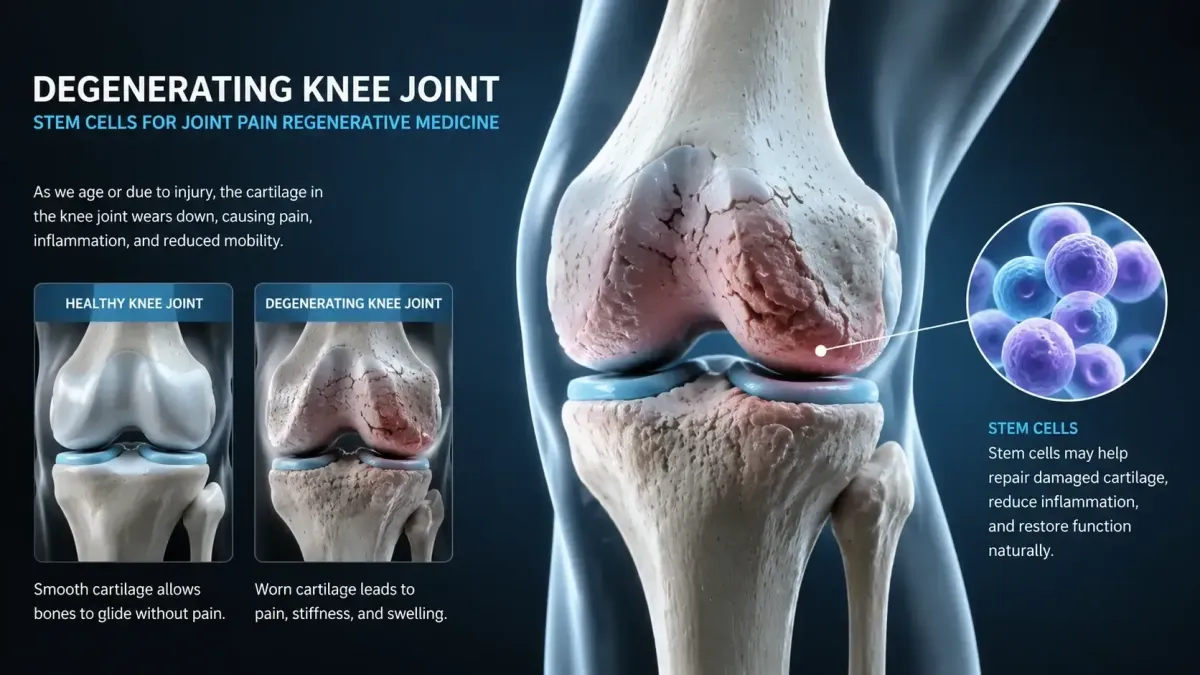
Joint degeneration is not simply mechanical wear, though that is how it is often described. It is a biological process. As cartilage thins and the joint surface changes, the local environment shifts into chronic low-grade inflammation. Inflammatory signaling accumulates. The cells that maintain cartilage struggle to keep pace with the breakdown. The result is a self-reinforcing cycle: mechanical change drives inflammation, and inflammation accelerates further breakdown.
This matters because the conventional interventions largely address one part of that cycle. Anti-inflammatories and cortisone suppress the inflammatory signaling temporarily, reducing pain, but they do not change the joint's underlying trajectory. When the effect wears off, the cycle resumes. That is why cortisone relief is real but repeatedly temporary — it treats a symptom of the process, not the process itself.
How MSC-based biologics signal repair at the cellular level
Mesenchymal stem cells — MSCs — are adult cells drawn from sources such as bone marrow and adipose tissue. The intuitive assumption is that they are injected into a joint and grow into new cartilage. That is largely not how the current science understands their function, and setting that expectation straight is essential to an honest conversation.
The research indicates that MSCs work primarily through signaling rather than replacement. They release biologically active molecules — growth factors, cytokines, and other compounds — that influence the joint environment: modulating inflammatory signaling, supporting the cells that maintain cartilage, and shifting the local biology away from the breakdown cycle. Much of this signaling is carried by exosomes. The mechanism is biological influence on the joint environment, not the construction of new tissue.
This distinction matters for expectations. A biologic that influences the joint environment is a different proposition from one that regrows a joint to its condition at 30. The first is what the evidence describes; the second is what overselling promises. Any source claiming one injection rebuilds your knee has left the science behind.
Why image-guided delivery matters
One clinical detail separates a serious orthobiologic program from a casual one: how the biologic is delivered. A biologic placed into the wrong part of the joint, or into surrounding soft tissue rather than the target structure, cannot do what it is intended to do.
At Valere, orthobiologic delivery is image-guided, using real-time ultrasound to confirm placement before the biologic is deployed. This is not a marketing upgrade — it is the difference between delivering a biologic to the specific structure the assessment identifies and approximating its location by feel. For a joint, where the anatomy is complex, that precision is directly connected to whether the approach has a chance of working. The joint renewal and mobility program at valereregenerative.com/offerings/joint-renewal-mobility-longevity is built around this standard.

The surgery-versus-biologics conversation, honestly
For some joints, surgery is the right answer. When structural damage is severe, when the joint is mechanically failing, when the functional limitation is profound, a well-chosen procedure can be the appropriate path — and a responsible practice will say so rather than steer you away from it. Nothing here argues against surgery when it is warranted.
What is worth questioning is surgery as an automatic default before a biologic approach has been seriously considered — particularly for the large category of joints where imaging shows degenerative change but the joint is not mechanically failing. In those cases the biological environment is addressable, and surgery's recovery cost is significant: months away from the activity that defines an active life. A biologic approach carries a fraction of that downtime. For the right candidate, it is a reasonable step to consider before a decision that cannot be undone.
The honest framing is comparative, not absolute. Surgery is definitive but costly in recovery and irreversible. Biologics are lower-risk and lower-downtime but with a less certain, more variable outcome. Which trade-off fits depends on the specific joint, the specific person, and an honest assessment of both.
What the evidence actually shows
This is where honesty matters most, because the evidence for MSCs in joint conditions is real but genuinely mixed, and any source presenting it as settled in either direction is misrepresenting it.
On the encouraging side, a 2024 systematic review and meta-analysis of randomized controlled trials found MSCs superior to placebo for relieving pain and improving function in knee osteoarthritis at twelve-month follow-up, without a significant difference in adverse events. At the same time, the same literature contains trials showing no meaningful advantage over placebo, and a 2025 analysis noted that a substantial portion of the observed improvement may be attributable to contextual and placebo-related effects. The related evidence on platelet-rich plasma reaches a comparable place —an effective option for many with knee osteoarthritis, but not a panacea.
The responsible reading is neither dismissal nor overstatement. The evidence supports MSC-based biologics as a reasonable, low-risk option worth considering for appropriate candidates, while more standardized research clarifies who benefits most. A practice calling the science conclusively proven is overstating; one calling it worthless is understating. The truth sits in the middle, and you deserve to hear it that way.
Who is — and isn't — a good candidate
Candidacy is established through a clinical assessment, not a description of symptoms. Broadly, the best-positioned people have pain and functional limitation from degenerative joint change or certain soft-tissue conditions, a joint that is not yet mechanically failing, a history of conventional measures that did not adequately resolve the problem, and a desire to make an informed decision before considering surgery.
It is less appropriate for those with advanced structural joint failure, where the mechanical damage is beyond what a biological approach can influence, and for those whose picture points clearly toward a surgical solution. In those cases, an honest assessment says so. A program that recommends the same biologic to everyone is not exercising clinical judgment.

How the FDA framework applies to joint biologics
A brief word on the regulatory reality, because it generates confusion specific to this area. The FDA regulates the biologic products used in joint programs — human cells and tissues — and requires the manufacturing laboratories to be registered and compliant. What it does not do is approve a specific injection protocol for a specific joint the way it approves a drug for a specific indication.
When MSC-based biologics are used for a joint, they are used off-label, sourced from FDA-registered laboratories, and administered under physician supervision — all three at once. This is the same structure governing much of everyday medicine, where physicians apply approved products using clinical judgment. A practice implying its specific joint protocol is FDA-approved is misstating the framework. Valere sources exclusively from FDA-registered, compliant laboratories.
Frequently Asked Questions
Are stem cell injections for joints legal? Yes, with the clarification above: the biologic products are FDA-regulated and the manufacturing laboratories must be registered and compliant, and the products are used off-label under physician supervision — legal and standard across medicine.
Will a stem cell injection regrow my cartilage? That is not how the current science understands the mechanism, and no honest source will promise it. MSC-based biologics appear to work by influencing the joint's biological environment rather than by directly rebuilding cartilage. Realistic expectations are part of the process.
How is this different from PRP? PRP concentrates growth factors from your own blood; MSC-based biologics involve cellular products from sources such as bone marrow, adipose, or compliantly sourced tissue. Both aim to influence the joint environment. Which is appropriate depends on the clinical picture, and the assessment determines that.
Is it covered by insurance? Generally no. Because these are elective, off-label biologic approaches rather than established standard of care, they are typically private-pay — a real consideration, best discussed directly.
The starting point
Stem cells for joint pain are neither the miracle nor the fraud the two extremes claim. For the right candidate — the right joint, the right clinical picture, honest expectations — a physician-guided biologic program is a reasonable, low-downtime option worth considering before an irreversible decision. The way to find out is a genuine clinical assessment, evaluated honestly and sourced compliantly.
Reserve your assessment atvalereregenerative.com/assessment.