IV Cellular Infusion: How Systemic Delivery of Exosome-Derived Biologics Works and Who It's For
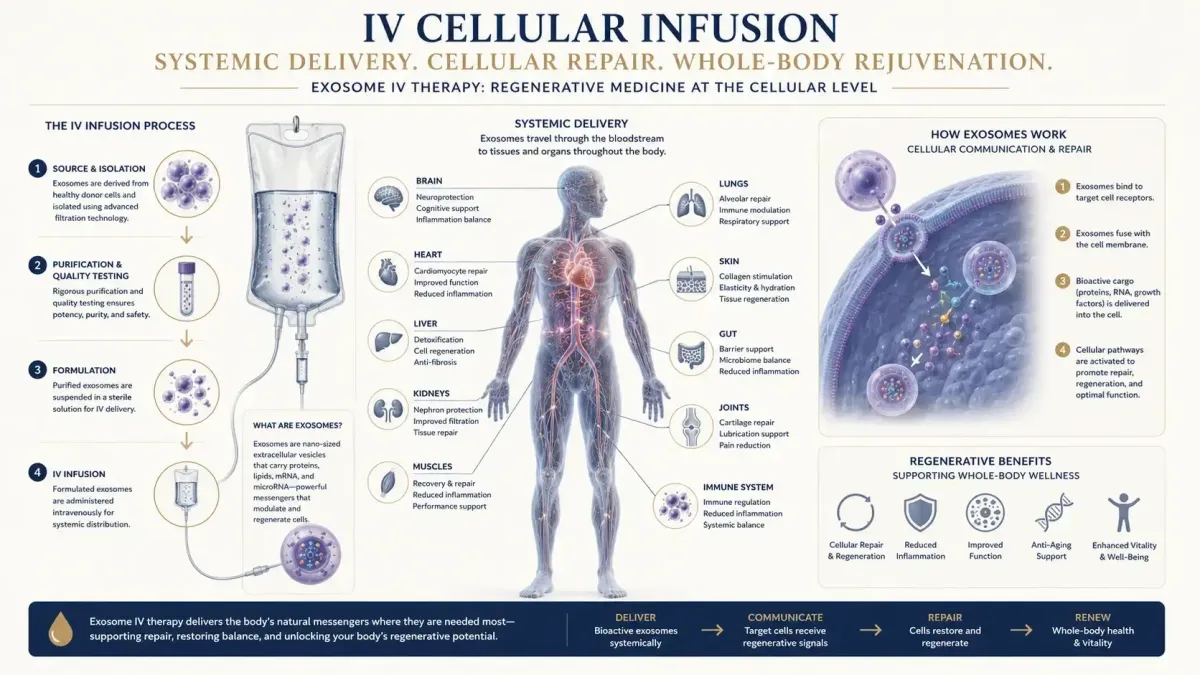
Most regenerative biologics are delivered to a specific place — a knee, a tendon, the skin of the face. IV cellular infusion is different in a way that matters: it delivers exosome-derived biologics, often alongside compounds such as NAD+, into the bloodstream, with the aim of a systemic rather than a localized effect. That difference changes both the rationale and, importantly, the standard of evidence and caution that should apply.
This is the area of regenerative medicine where marketing has drifted furthest from data, so precise, honest framing matters most. What follows is how systemic delivery differs from a localized injection, what exosome biologics and NAD+ are proposed to do when infused, what the human evidence does and does not support, who might reasonably consider it, and why candidacy assessment is especially important here. For the broader scientific and regulatory context, the pillar article on stem cells in regenerative medicine covers the field.
Why systemic delivery is biologically different from a localized injection
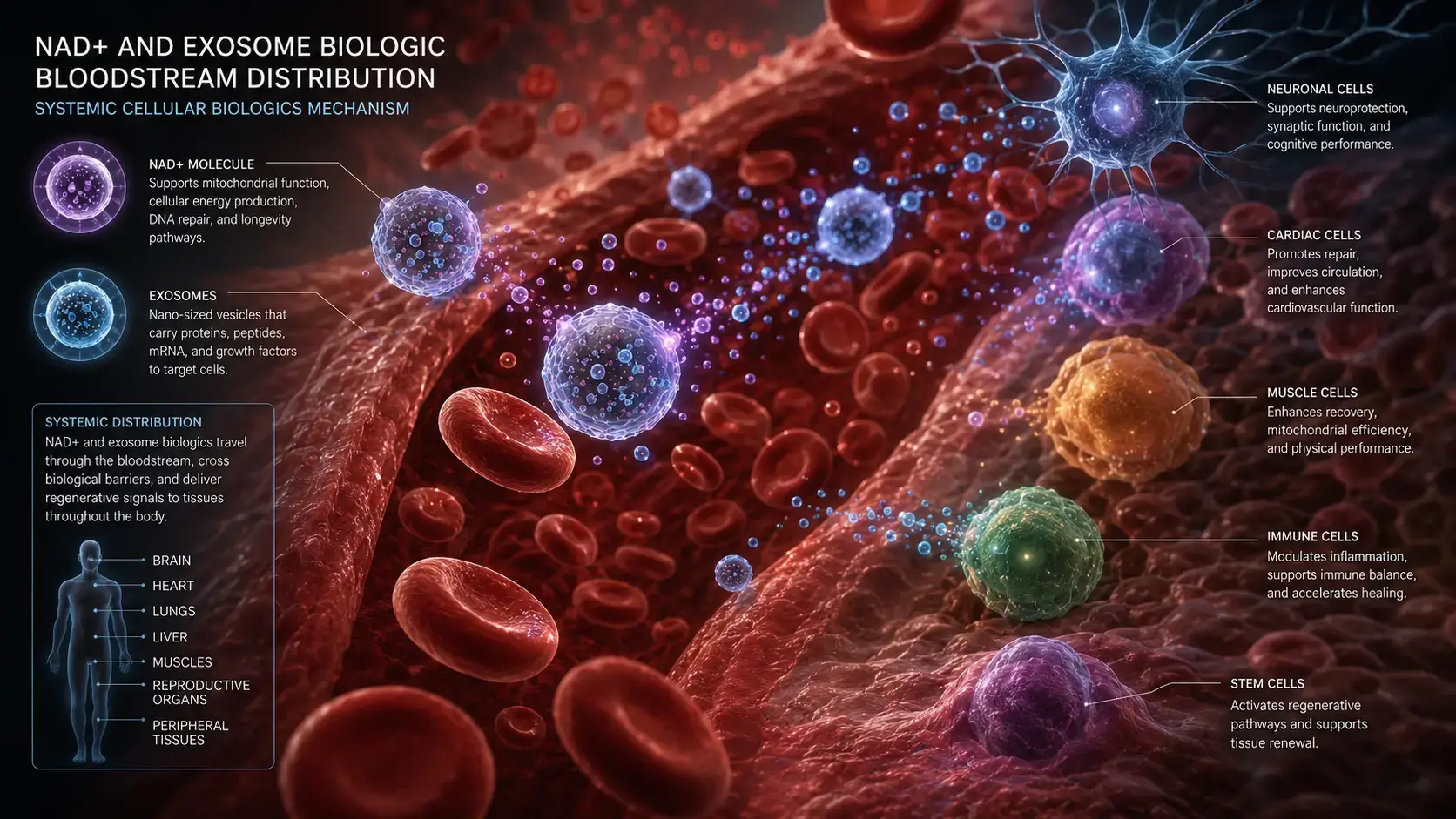
When a biologic is injected into a joint, its activity is concentrated there. When infused intravenously, it is distributed through the circulation and its potential effects are systemic — reaching tissues throughout the body rather than one target structure. That is the entire rationale for the IV route: to influence the whole system rather than a single region.
This systemic distribution is also why the IV route demands more caution, not less. A localized injection has localized effects and localized risks. A systemic infusion introduces a biologic into the whole body, raising the bar for both the quality and sourcing of what is infused and the clinical oversight under which it is done. The broader the potential reach of an intervention, the more sourcing and supervision matter.
What exosome biologics and NAD+ are proposed to do when infused
Two distinct things are often combined in these protocols, and it helps to separate them clearly.
Exosome-derived biologics, when infused, are proposed to exert the same signaling effects that define them elsewhere — modulating inflammation and supporting cellular repair processes — but distributed systemically rather than concentrated at one site. In clinical research, intravenous infusion is one of the predominant routes studied for these products, particularly in inflammatory conditions.
NAD+ is a different kind of compound entirely. It is a coenzyme central to cellular energy production and repair, and its levels decline with age. The premise behind NAD+ infusion is straightforward: if declining NAD+ contributes to reduced cellular energy and repair capacity, restoring it might support those functions. IV delivery is used because it raises NAD+ availability directly, bypassing the digestive tract. The premise is biologically coherent. Whether it translates into the wellness outcomes it is marketed for is a separate question, addressed below.
What the evidence actually supports — and what it does not
Here the honesty has to be unusually direct, because this is where overstatement is most common and the gap between marketing and data is widest.
On exosome biologics: a review of MSC-derived extracellular vesicle clinical trials from 2014 to 2024 confirms intravenous infusion is among the most-studied routes, while stating plainly that a lack of standardized protocols and dose optimization has limited clinical translation. On safety specifically, a 2025 systematic review and meta-analysis of intravenous MSC therapy across 36 studies found no statistically significant increase in adverse event risk compared to controls— a reasonable safety signal, though safety is not the same as proven benefit.
On NAD+: the evidence is more deflating than the marketing suggests. A 2026 PRISMA-guided systematic review found that NAD+ supplementation raises NAD+ levels in blood and tissue — clear biological activity — but that clinical effectiveness for anti-aging or wellness outcomes remains inconclusive. Most pointedly, it found no outcome trials at all testing intravenous or intramuscular NAD+ for anti-aging or wellness indications, and a separate 2023 review found insufficient evidence that IV NAD+ improves fatigue or energy in healthy adults. The biological rationale is real; the specific IV-route human evidence is thin.
An important boundary: what this is not
One point has to be stated without hedging, because it is both a matter of honesty and a matter of law. IV cellular infusion, whether exosome-based or NAD+-based, is not an established treatment for any specific disease, and it should never be presented as one.
The FDA has not approved these infusions as treatments for any disease or condition, and no NAD+ or exosome infusion product is FDA-approved for the wellness indications it is commonly marketed toward. Where you see these therapies advertised as treatments for named diseases — neurological, cognitive, or otherwise — that framing has moved beyond both the evidence and what is permitted. This article addresses systemic infusion strictly in the context of general wellness and cellular support, not as treatment for any diagnosed condition.
Who might reasonably consider it
Within that honest framing, those who might reasonably consider IV cellular infusion are generally people pursuing general wellness and cellular support rather than treatment for a specific illness — adults interested in systemic support as part of a broader longevity-oriented approach, or those with general fatigue or slow recovery who have first had genuine medical causes properly evaluated.
That last qualifier is essential. Fatigue, low energy, and poor recovery have real and often treatable medical causes — thyroid dysfunction, anemia, sleep disorders, hormonal imbalance, cardiovascular and metabolic issues. Reaching for a systemic infusion before those are evaluated is the wrong order. An honest program investigates the treatable causes first and considers systemic support only within that fuller picture, never as a substitute for a proper workup.
Why candidacy assessment matters especially here
Assessment matters everywhere in regenerative medicine, but the systemic nature of IV infusion raises the stakes. Because the intervention affects the whole body, the evaluation of whether it is appropriate carries more weight than for a localized treatment.
A proper assessment for systemic infusion covers overall health, the actual cause of the symptoms, existing conditions and medications, and whether a better-established intervention is the more appropriate path. It also involves the sourcing question: because a biologic is introduced systemically, the requirement that it come from an FDA-registered, compliant laboratory is not a formality but a genuine safety issue. The IV therapy and cellular infusion program at valereregenerative.com/offerings/iv-therapy-cellular-infusion is built around that assessment-first, honestly-framed approach.

How the FDA framework applies to IV-administered biologics
This is the highest-stakes regulatory framing in regenerative medicine, so it deserves the most precision. The FDA regulates the biologic products used in these infusions and requires the manufacturing laboratories to be registered and compliant. It has not approved specific IV protocols, and there are no FDA-approved exosome or NAD+ infusion products for wellness or anti-aging indications.
When exosome biologics are used via IV infusion, they are used off-label, sourced from FDA-registered laboratories, and administered under physician supervision — all three at once. Because the route is systemic, the sourcing standard carries more weight here than anywhere else in regenerative medicine: what is infused reaches the entire body. Valere sources exclusively from FDA-registered, compliant laboratories, describes the evidence accurately rather than implying approval or proven benefit, and does not present systemic infusion as a treatment for any disease.
Frequently Asked Questions
Does IV NAD+ therapy work for anti-aging? The biological rationale is real — NAD+ declines with age and infusion raises its levels — but the specific human evidence for IV NAD+ producing anti-aging or wellness outcomes is thin, and a recent systematic review found no outcome trials testing the IV route for these indications. It should be approached with realistic expectations, not marketing confidence.
Is IV exosome or stem cell infusion safe? A 2025 meta-analysis of intravenous MSC therapy found no statistically significant increase in adverse event risk versus controls, which is a reasonable safety signal. Safety is not proof of benefit, and the sourcing of what is infused is a genuine safety factor given the systemic route.
Can this treat a disease or neurological condition? No. These infusions are not FDA-approved treatments for any disease, and they should not be presented or pursued as treatment for a diagnosed condition. This is general wellness and cellular support only.
Is it covered by insurance? No. Systemic infusion for wellness is elective and off-label, and is private-pay.
The starting point
IV cellular infusion rests on coherent biological premises and a human evidence base that is genuinely limited — particularly for the IV route and particularly for the wellness outcomes it is marketed toward. Its systemic nature is exactly why honest framing, compliant sourcing, and a real assessment matter more here than anywhere else in regenerative medicine. It is general wellness support for the right person, evaluated properly — not a treatment, and not a shortcut around a proper workup.
The way to find out whether it makes sense for you, and what should be addressed first, is a genuine assessment. Reserve yours atvalereregenerative.com/assessment.