Stem Cells for Hair Loss: What Cellular Biologics Do at the Follicle Level
If you have started researching stem cells for hair loss, you have probably noticed that the confidence of the marketing does not match the caution of the science. Clinics describe dramatic regrowth. The peer-reviewed literature uses words like preliminary and limited. That gap is worth understanding before you spend anything, and this article is written to close it — honestly, without softening the parts that deserve caution.
What follows is what cellular biologics actually do at the follicle level, what the current evidence does and does not support, and who is a reasonable candidate. For the wider scientific and regulatory context on these biologics, the pillar article on stem cells in regenerative medicine covers the field as a whole.
What is actually happening at the follicle
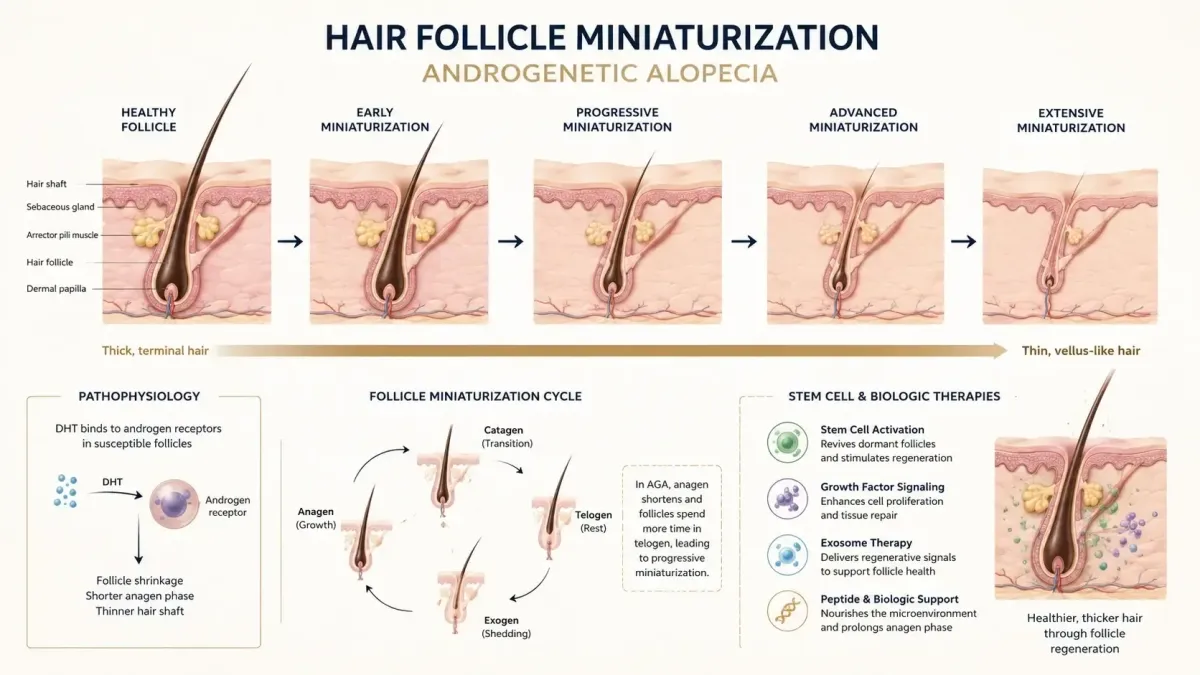
To understand what a biologic approach is attempting, you first have to understand what goes wrong in the most common form of hair loss. In androgenetic alopecia — pattern hair loss — the problem is follicle miniaturization. Under the influence of dihydrotestosterone (DHT), susceptible follicles progressively shrink. The growth phase of the hair cycle shortens. Each cycle produces a finer, shorter hair, until the follicle produces little more than fine, barely visible growth.
This is a gradual biological process, not a sudden failure. The follicles are not immediately destroyed — they are progressively downregulated, spending less time growing and producing weaker hair each cycle. That distinction matters enormously for what any intervention can realistically do, because a follicle that has miniaturized but is still active is a different target than one that is gone entirely.
How exosome-based biologics interact with the follicle
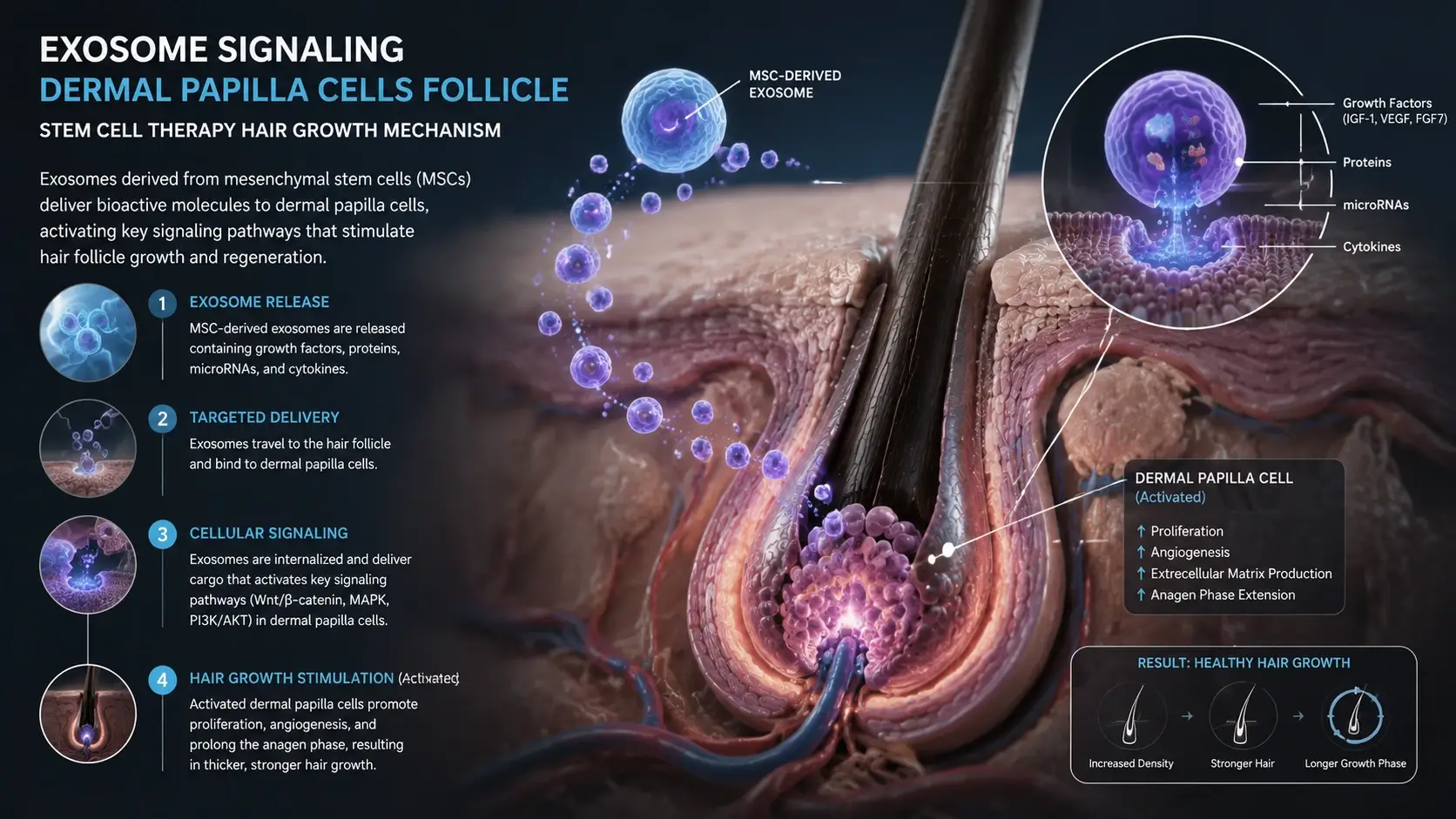
Cellular biologics in this space — primarily exosomes derived from mesenchymal stem cells — work through signaling, not replacement. Exosomes are nanoscale vesicles that cells use to carry biological instructions to one another. In the context of the follicle, the mechanism under study is their interaction with the dermal papilla cells, the signaling center at the base of the follicle that governs the hair cycle.
In laboratory and preclinical work, exosomes have been shown to influence dermal papilla cell activity, support the local blood supply that follicles depend on, and modulate the signaling pathways involved in the hair growth cycle. The biological rationale is coherent: if miniaturization is driven by disrupted signaling to the dermal papilla, a biologic that supports healthier signaling to those cells is aimed at the right target.
But a coherent mechanism is not the same as a proven outcome, and this is where honesty is required. The distinction between what has been demonstrated in a laboratory model and what has been demonstrated in human beings is the entire question — and in hair loss, that gap is wide.
Why this is different from topical treatments and cosmetic coverage
It is worth being clear about what category this is and is not. A biologic approach is not a cosmetic product that coats or thickens the appearance of existing hair, and it is not a fiber or concealer that creates the look of density. Those products change appearance without touching the underlying biology.
A biologic approach is attempting something biological — to influence the signaling environment of the follicle itself. That is a more ambitious target than cosmetic coverage, and it is also a more uncertain one. It is closer in concept to how platelet-rich plasma has been used for hair, where growth factors from your own blood are used to influence the follicular environment, than to anything applied to the surface. Whether it delivers on that ambition in a given person is a clinical question, not a marketing one, and it is answered by an honest assessment rather than a promise.
What the evidence actually shows
This is the section that most sources selling this treatment skip, so it is the one worth reading most carefully. The honest summary is that the biological rationale is promising and the human evidence is preliminary.
A 2025 review of exosome use in human subjects, from dermatologists at Columbia and Weill Cornell, concluded that while preclinical studies suggest exosomes may support hair growth by stimulating dermal papilla cells and promoting blood supply, very limited data are available on the safety and efficacy of exosome use in actual patients. A 2024 dermatology review was more pointed still, noting that no exosome-based treatment has been approved for hair loss and that no technique has been proven to create new follicles or reverse the miniaturization of existing ones. The existing human studies are largely small — case series and early trials — rather than the large, controlled studies that establish a treatment.
None of this means the approach is worthless. It means it is genuinely emerging, that the evidence supports cautious consideration rather than confidence, and that anyone presenting it as an established solution with predictable results is misrepresenting where the science currently stands. A practice worth trusting will tell you this plainly rather than around it.
Who is — and isn't — a reasonable candidate
Because the underlying biology involves miniaturized-but-active follicles, the timing of the hair loss matters more here than almost anywhere else. A reasonable candidate is generally someone earlier in the process, with thinning and miniaturization but follicles that are still active — where there is still a biological target to influence.
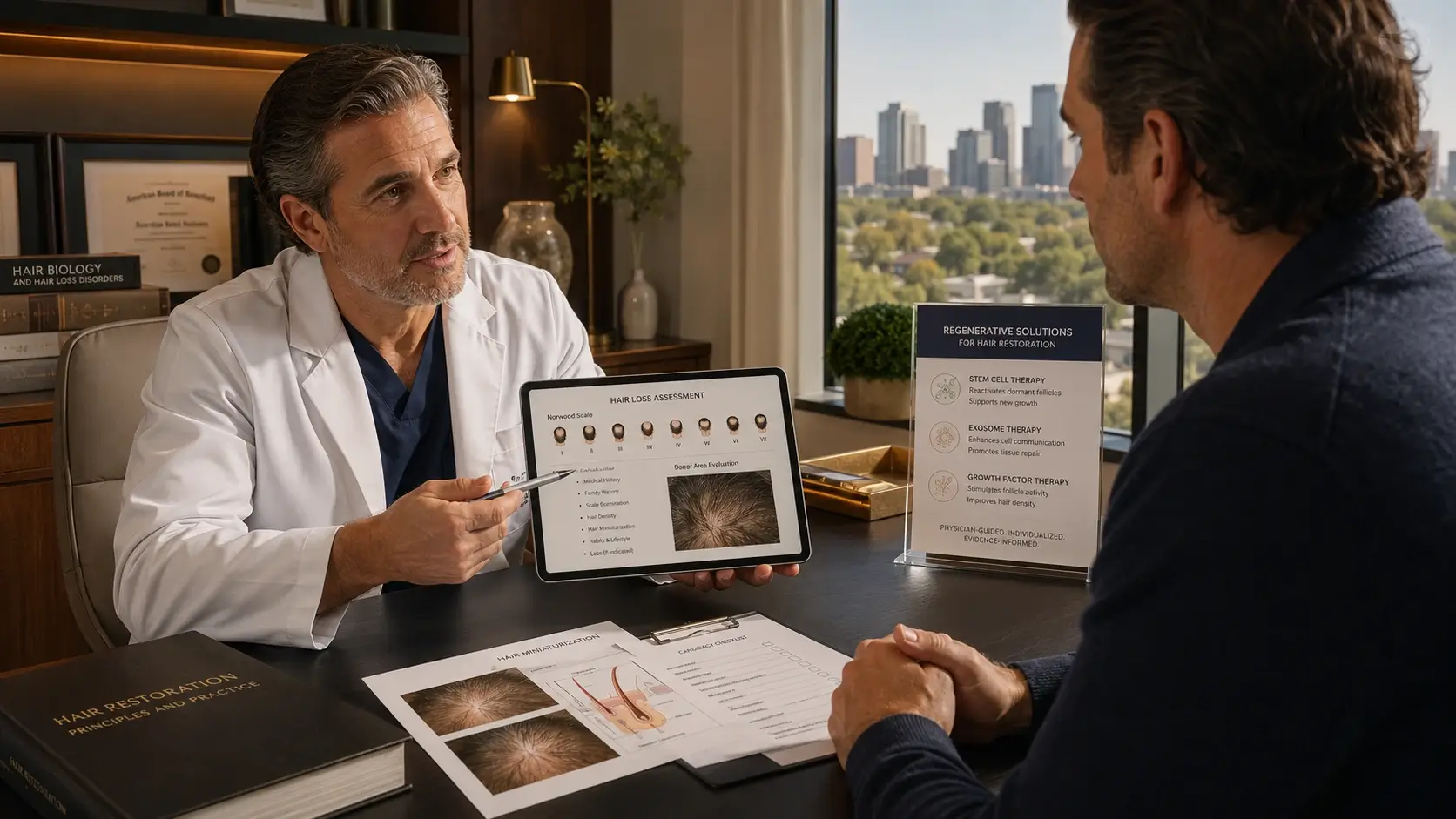
The person for whom this is not appropriate is the one expecting regrowth in areas of long-established, complete baldness, where the follicles are no longer present to respond. No biologic signals a follicle that is gone. Diffuse thinning with retained follicles is a more plausible target than a fully bald scalp region, and an honest assessment will distinguish between the two rather than promising both. This is also why the assessment matters: it establishes what is actually addressable in your specific situation before anything is recommended. The hair rejuvenation and follicular health program at valereregenerative.com/offerings/hair-rejuvenation-follicular-health is built around that assessment-first approach.
How the FDA framework applies to hair biologics
The regulatory picture deserves particular care here, because it is specific. The FDA regulates exosome and cellular biologic products, and requires the laboratories that manufacture them to be registered and compliant. The FDA has not approved any exosome product as a treatment for hair loss — and in fact issued a public safety notification about exosome products in 2019, which is one more reason compliant sourcing and honest framing are not optional in this space.
When these biologics are used for hair, they are used off-label, sourced from FDA-registered laboratories, and administered under physician supervision. All three conditions must hold at once. This is the same off-label structure that governs much of medicine, but the presence of an FDA safety notification in this specific area makes the sourcing standard especially consequential. Valere sources exclusively from FDA-registered, compliant laboratories — and is direct about the preliminary state of the evidence rather than implying more certainty than exists.
Frequently Asked Questions
Can stem cells regrow hair I have already lost? Not in areas where the follicles are gone. The mechanism under study involves supporting miniaturized-but-still-active follicles, not creating new ones. No technique has been proven to reverse complete follicle loss, and any source promising otherwise is overstating the science.
Is this proven to work? The biological rationale is promising, but the human evidence is preliminary — mostly small studies rather than large controlled trials. It is reasonable to consider with honest expectations; it is not an established, predictable solution, and it should not be presented as one.
How is this different from PRP for hair? PRP uses growth factors concentrated from your own blood to influence the follicular environment; exosome biologics use cellular signaling products from other sources. Both aim at the follicle's biology rather than the surface. Which, if either, is appropriate is a clinical question the assessment addresses.
Is it covered by insurance? Generally no. These are elective, off-label biologic approaches rather than established standard of care, so they are typically private-pay.
The starting point
Cellular biologics for hair loss are an emerging approach with a coherent biological rationale and an evidence base that is still early. For the right candidate — earlier in the process, with follicles still active, and with honest expectations about what preliminary evidence means — it may be worth considering as part of a physician-guided conversation. For the wrong candidate, no honest practice should promise what the biology cannot deliver.
The way to find out which describes your situation is a genuine assessment. Reserve yours atvalereregenerative.com/assessment.