Why Your Shoulder Hurts on the Tennis Court — and What a Regenerative Plan Actually Does About It
Why Your Shoulder Hurts on the Tennis Court — and What a Regenerative Plan Actually Does About It
Medical oversight: Micah Craig, MD, Medical Director, Valere Regenerative
The shoulder pain that develops in a tennis player over years of serious play rarely arrives with a clear event. It does not announce itself with a single injury or a dramatic mechanical moment that the player can point to as the origin. It develops gradually, across the accumulated workload of thousands of serves, overhead shots, and lateral reaching movements, until it is present consistently enough that the player begins actively managing it rather than ignoring it.
Managing it means modifying the serve. Being conscious of the overhead on the critical point. Taking more time to warm up. Needing more recovery after a match than the game itself should require. Waking the morning after tennis with a shoulder that did not feel this way five years ago. The patient who plays two or three times a week and has been doing so for decades recognizes this pattern in specific and personal detail.
What they often do not have is a clear picture of what is actually happening in the shoulder at the biological level, why the cortisone injection cycle they have been in has not resolved it, and what a regenerative clinical plan can actually do about it. This article provides that picture.
What Is Happening in the Tennis Shoulder
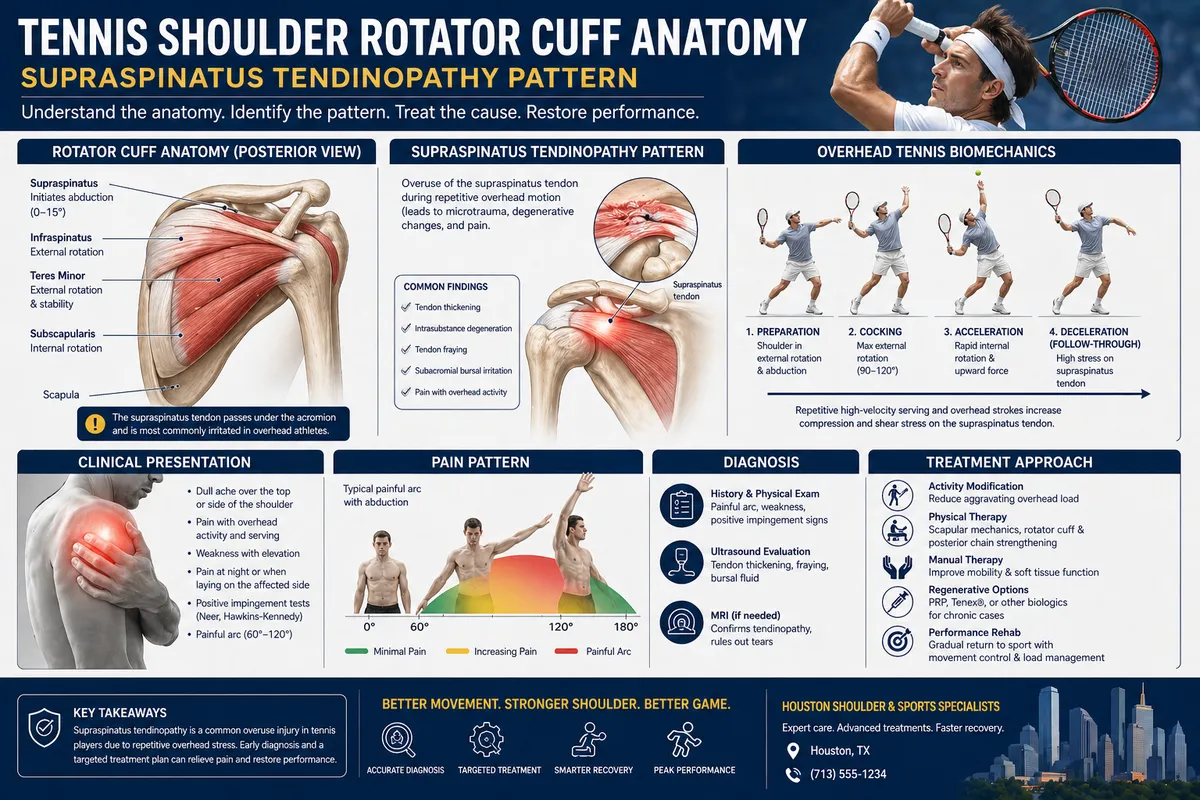
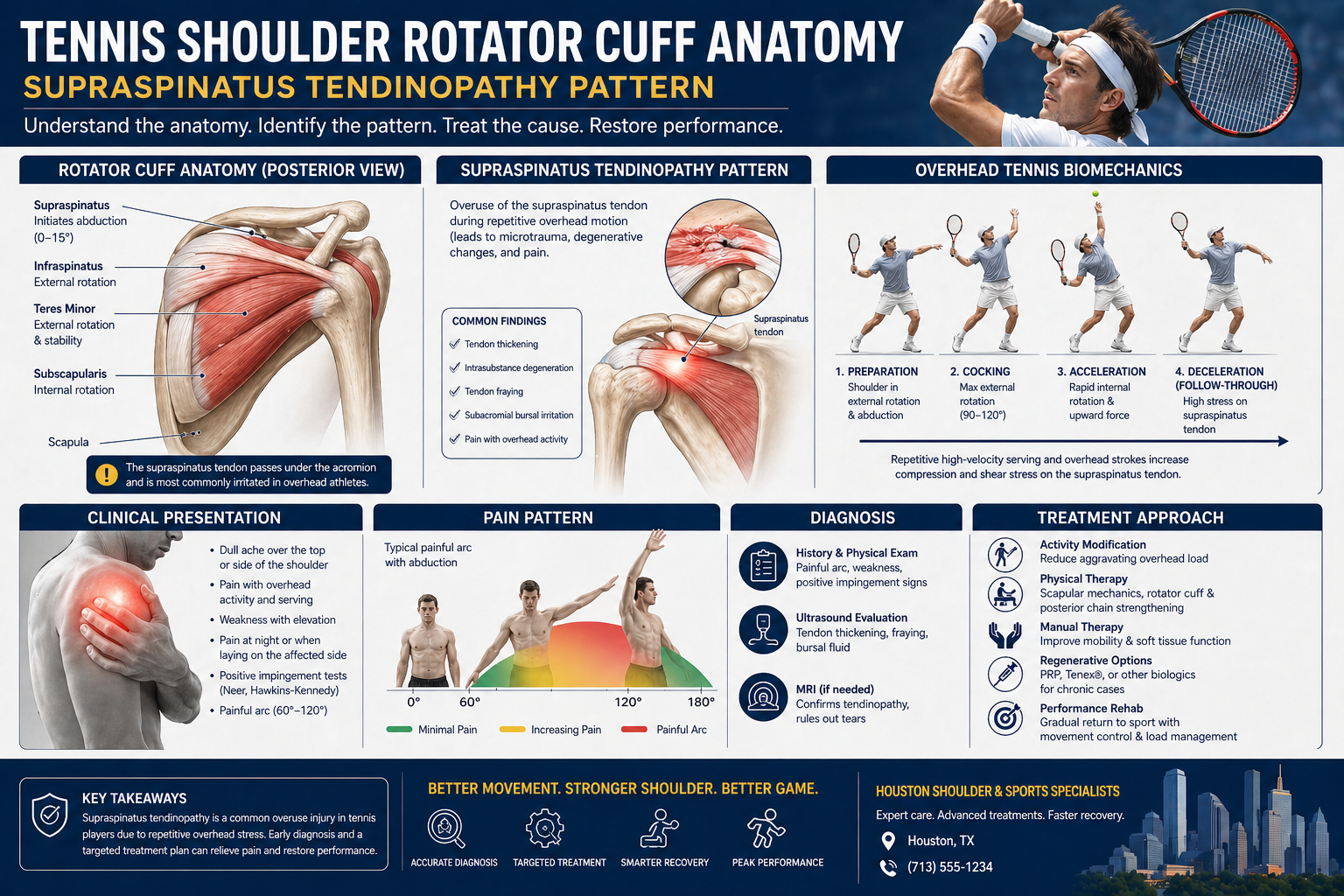
The tennis shoulder is most commonly a story of the rotator cuff, specifically the supraspinatus and infraspinatus tendons that are most directly loaded by the overhead mechanics of the serve and the internal rotation demands of the ground strokes. These tendons are among the most demanding tissue structures in the body — required to generate force, absorb load, and maintain the stability of a joint with an extraordinary range of motion simultaneously.
The biological failure that underlies chronic tennis shoulder pain is tendinopathy: a degenerative change in the tissue structure of the tendon driven by accumulated load that exceeds the tissue's capacity for repair and remodeling. In tendinopathy, the organized, parallel collagen structure of healthy tendon becomes disorganized. The cellular population changes. The mechanical properties of the tissue decline. And the tissue enters a state of chronic pain and functional limitation that rest and anti-inflammatories address only transiently.
This distinction — between tendinopathy and acute injury — is clinically important because it changes the approach required. Tendinopathy is not a tear waiting to be repaired surgically. It is a biological failure of the tissue's maintenance processes that may call for a different kind of approach. Understanding this is the foundation for understanding why the regenerative approach is different from the cortisone cycle.
In cases where the assessment reveals a partial or full-thickness rotator cuff tear rather than tendinopathy alone, the clinical approach adjusts accordingly. These are not the same condition and they do not respond identically to the same interventions. The assessment is where the distinction is established.
What the Cortisone Cycle Actually Delivers
Cortisone reduces inflammation. In the short term, this reduction in inflammation produces meaningful pain relief — often dramatic — that allows the patient to return to the court. The injection is effective at what it does. The problem is what it does not do.
Cortisone does not change the biological condition of the tendon. The tendinopathy that was driving the inflammation before the injection is still present after it. The underlying tendon condition remains. The pain returns as the cortisone effect wanes because the underlying condition has not been addressed.
Repeated cortisone injections into a tendon also have an effect on the tissue itself — research suggests repeated corticosteroid exposure may affect collagen integrity in tendon tissue. The cycle of relief and return is not neutral from a tissue perspective. It is a reason to talk with a physician about other options.
What a Regenerative Program for the Tennis Shoulder Involves
The regenerative program for the tennis shoulder at Valere begins with the assessment. Imaging review, clinical examination, and a detailed conversation about the specific pattern of the pain, the demands of the game that provoke it, and the patient's functional goals provide the clinical picture from which the program is built.
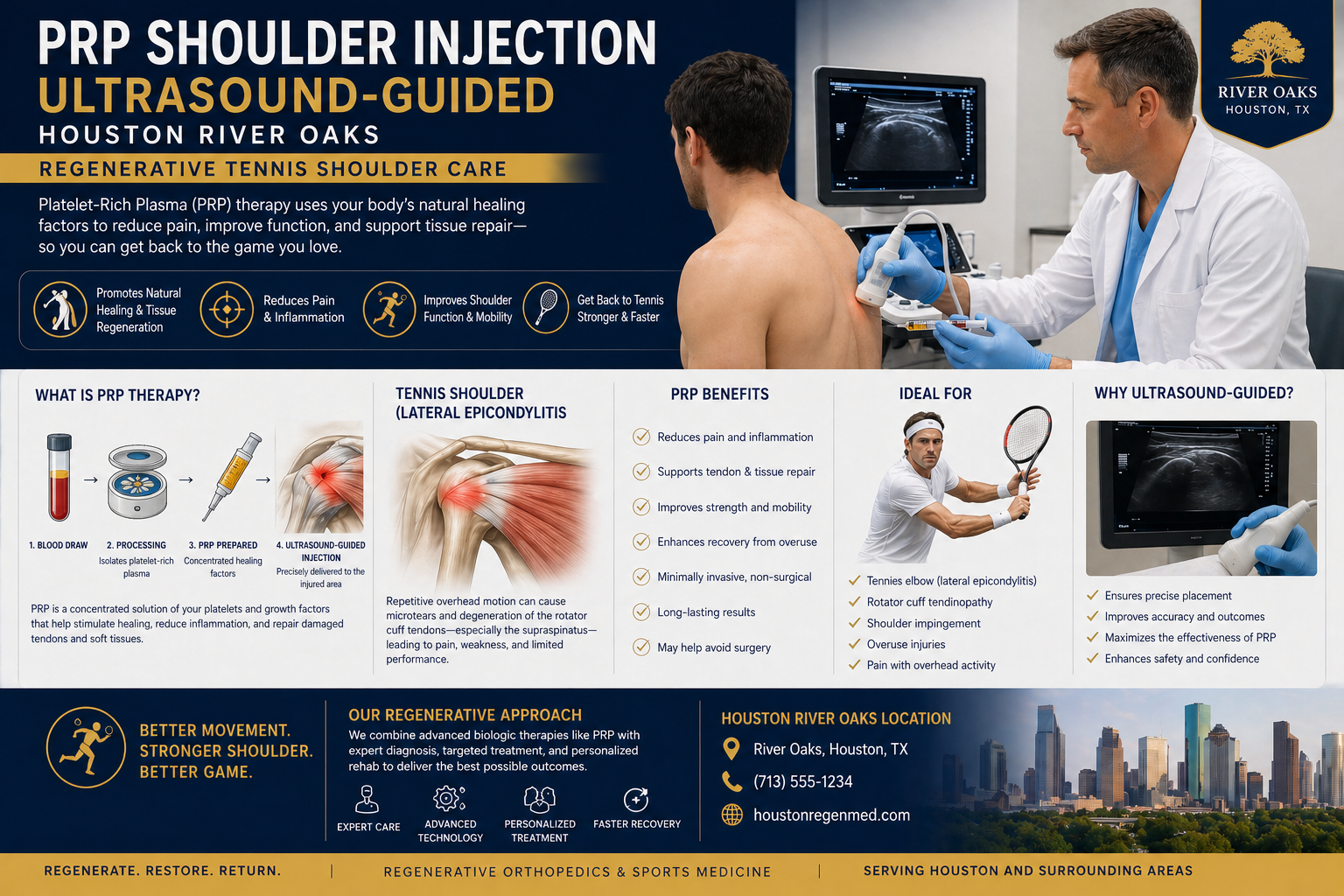
For the patient with rotator cuff tendinopathy — the most common finding — the program typically centers on exosome therapy delivered under ultrasound guidance to the specific tendon identified by the assessment as the primary driver of the symptoms, often paired with StemWave. Exosomes carry signaling molecules involved in the body's own repair processes; the aim is to support the tendon's maintenance processes, and how much a given shoulder responds varies from person to person. Exosome therapy for orthopedic cases typically starts at $2,250, depending on the case.
Precision in delivery matters in the shoulder even more than in some other joints. The rotator cuff tendons are small structures in a complex anatomical neighborhood. Ultrasound guidance helps place the preparation at the target tissue rather than the surrounding structures. At Valere, this precision is the standard for every orthobiologic joint intervention.
The program also includes a structured loading progression — a plan for returning the shoulder to the demands of the tennis game gradually and with clinical oversight. The patient is not told to stop playing indefinitely. They are given a program that manages the return to their game as a clinical process with defined milestones.
The joint renewal and mobility offerings at valereregenerative.com/offerings/joint-renewal-mobility-longevity outline how the program is structured for upper extremity concerns. If you are in the cortisone cycle and want to find out whether your shoulder is a candidate for a different approach, the starting point is the assessment at valereregenerative.com/assessment.
When the Shoulder Assessment Reveals a Tear Rather Than Tendinopathy
Not every shoulder that hurts on the tennis court is a tendinopathy story. In some patients — particularly those who have been playing at high intensity for many years, who have had a specific event they can point to, or whose imaging shows findings beyond the degenerative tendinopathy pattern — the assessment may reveal a partial or full-thickness rotator cuff tear that requires a different clinical conversation.
Partial tears exist on a spectrum. Small partial tears in the context of a tendinopathy background may be candidates for a regenerative approach, depending on the assessment. Larger tears or full-thickness tears in which structural repair is clinically indicated may point toward a different pathway, and the assessment at Valere will say so directly. Honest clinical guidance about the distinction is part of what the physician-led model provides.
The patient who has been told they have a tear and who wants to understand whether a regenerative approach is clinically appropriate for their specific finding — rather than assuming surgery is the only answer or assuming regenerative care is universally applicable — deserves exactly the kind of assessment-based clinical judgment that Valere provides. Reserve yours at valereregenerative.com/assessment.
The honest clinical picture — not a general statement about whether injections help shoulders, but a specific evaluation of your shoulder — is the starting point for the right decision.
Medical disclaimer: This article is for general education only and is not medical advice. Reading it does not create a doctor–patient relationship. The treatments discussed are not right for everyone, individual results vary and are not guaranteed, and some therapies mentioned may be used off-label or are not FDA-approved for the uses described. Please talk with a licensed physician about your own health before starting any treatment.