What Makes Valere Regenerative Different from Other Regenerative Clinics in Houston
What Makes Valere Regenerative Different from Other Regenerative Clinics in Houston
Medical oversight: Micah Craig, MD, Medical Director, Valere Regenerative
You have done your research. You know the terminology. You have read about orthobiologics, looked at before-and-after testimonials from three different clinics, and sat through at least one consultation where someone tried to sell you a package before answering your questions. You are not looking for more information about regenerative medicine in general. You are looking for the right place — and you have learned, through experience, that those are very different searches.
Houston has no shortage of clinics offering regenerative treatments. What it has very few of is physician-led regenerative practices built around a plan rather than a procedure. Valere Regenerative, located in River Oaks, is built on that distinction. Understanding what it means — and why it matters to your care — is the point of this article.
The Difference Between a Procedure and a Plan
Most regenerative clinics in Houston are procedure-forward. A patient comes in with knee pain, the clinic offers an injection, the injection is scheduled, and the relationship ends there. There is nothing inherently wrong with a single injection. The problem is that a single procedure delivered without diagnostic context, without a sequenced protocol, and without ongoing clinical judgment is not a plan. It is a transaction.
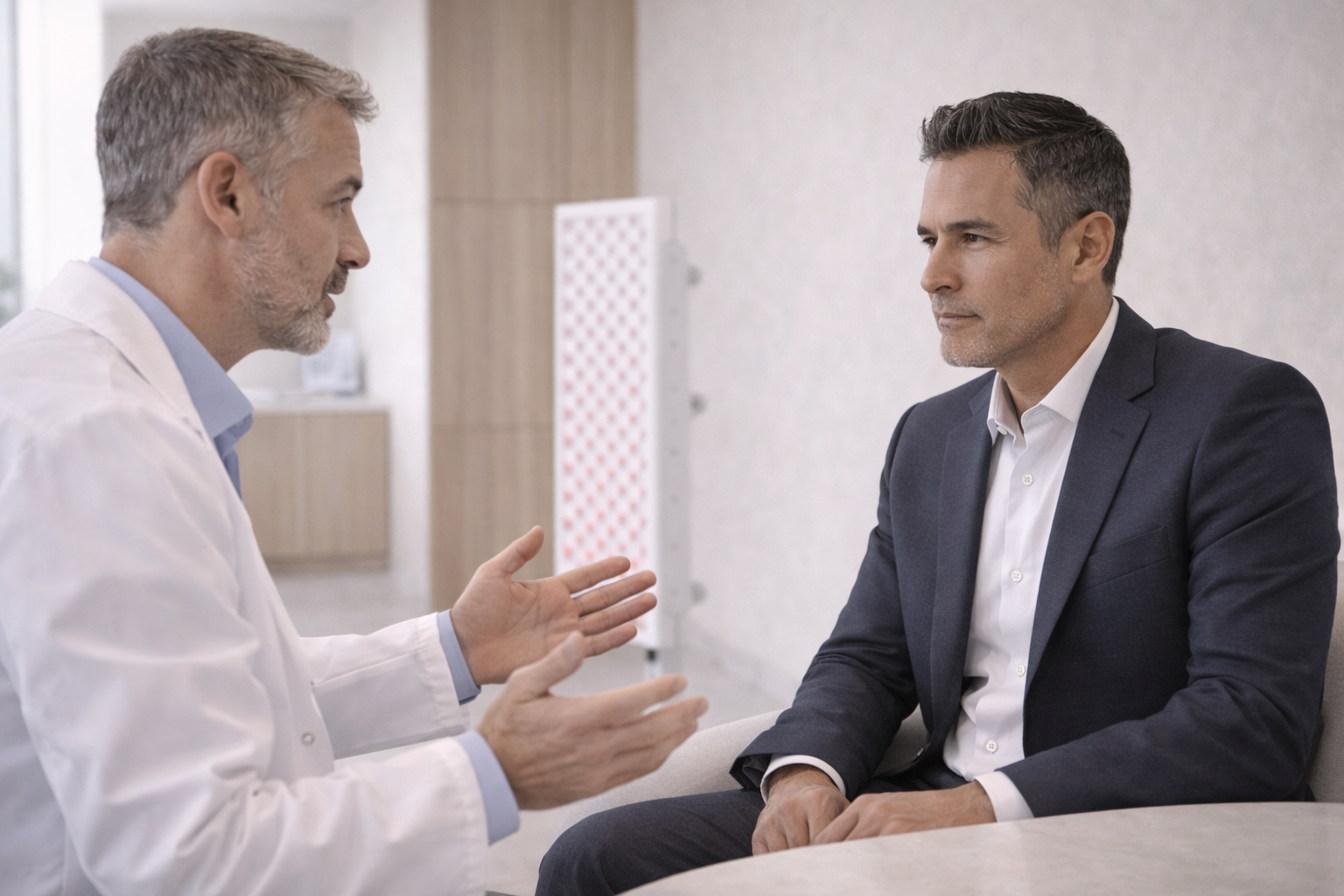
At a physician-led regenerative clinic in River Oaks, the entry point is an assessment — not a treatment menu. Before any intervention is discussed, a physician builds a clinical picture: the specific nature of the tissue involved, the degree of biological capacity for repair, the activity demands and life priorities of the individual patient, and the realistic trajectory of outcomes given all of those variables. That assessment becomes a roadmap. The roadmap becomes the program. The program is how progress is tracked and adjusted.
Every patient deserves a plan. Not a procedure. A plan built around the life they refuse to give up.
This is not a philosophical distinction. It is a clinical one. Valere believes orthobiologic care is best delivered within a structured protocol rather than as a standalone intervention. The physician is not the person who administers the injection. The physician is the person who determines whether the injection is the right intervention, at the right time, in the right tissue, as part of the right sequence.
What Physician-Led Actually Means — and What It Doesn't
The phrase "physician-led" appears frequently in Houston regenerative medicine marketing. It has been stretched to the point where it sometimes means little more than a physician signing off on protocols developed by someone else. At Valere, it means something specific.

It means the physician is present — in the room, in the consultation, in the treatment planning process, and in the follow-through. It means clinical judgment is applied at every stage, not just at the point of entry. And it means the physician relationship is continuous, not episodic.
For a patient who has experienced the alternative — a brief consultation with a practitioner who is clearly working from a scripted protocol, followed by a treatment delivered by someone they have never met — the contrast is immediate. The experience of being seen as a specific person with a specific biology, rather than a diagnosis category with a corresponding procedure, is not a luxury add-on. It is how care at Valere is meant to be delivered.
Concierge regenerative medicine in Houston at this level is uncommon. The majority of practices either offer physician access without program depth, or program depth without genuine physician presence. Valere is built to deliver both — which is why the patient-to-physician ratio is kept at a level that makes it possible.
The Role of Image Guidance — Precision Is Not Optional

One of the clearest clinical differentiators in regenerative medicine is whether orthobiologic injections are delivered under image guidance. The data on this point is not ambiguous. Studies in musculoskeletal medicine have demonstrated that blind injections — those delivered without ultrasound or fluoroscopic guidance — miss their target at rates that would be considered unacceptable in any other field of precision medicine.
For a patient considering orthobiologics in Houston, this matters in a concrete way: the biological material being injected — whether exosomes or other orthobiologics — is only as effective as its placement. A precisely formulated preparation delivered to the wrong anatomical location does not produce the response that the same preparation delivers when placed accurately under real-time imaging.
At Valere, image-guided delivery is standard — not a premium tier, not an optional upgrade. It is part of what it means to practice at the level the patient expects and deserves. To explore the specific orthobiologic protocols used at Valere, the regenerative orthopedic program outlines the clinical approach in detail.
Why the River Oaks Location Is Not Incidental
River Oaks is not simply an address. For a practice built around privacy, discretion, and a care experience that matches the standards its patients apply to every other dimension of their lives, location is a clinical decision as much as a logistical one.

The patients Valere serves — active executives, high-performing adults between 45 and 75, individuals who have built demanding lives and intend to continue living them fully — do not want to navigate a medical complex, wait in a shared waiting room, or feel that their care is being processed rather than delivered. The River Oaks setting makes possible the kind of private, unhurried, physician-direct experience that the clinical model requires.
This is also where the concierge structure matters. Valere operates with the access model of a private practice: direct physician communication, minimal administrative friction, and care that adapts to the patient's schedule and priorities rather than the reverse. For someone managing a complex professional life, the ability to receive a serious clinical program without the logistical burden of a traditional medical system is not a convenience. It is a condition of the program actually being followed.
To understand the full philosophy behind the practice, the Valere Institute page offers the clearest articulation of why the practice was built the way it was.
Biological Resilience as a Goal — Not Symptom Relief
This is perhaps the sharpest distinction between Valere and most regenerative medicine offerings in Houston: the goal is not relief. The goal is resilience.
Relief is a low bar. A cortisone injection can produce relief. An NSAID can produce relief. Even doing nothing can produce temporary relief when a flare subsides. Relief addresses the symptom at the moment of presentation. It does not address the biological trajectory that created the symptom — and it does not change that trajectory.
Biological resilience means something different. It means the capacity of the body's own systems to maintain function, repair damage, and adapt to physical demand over time. It means a program aimed not only at how a joint feels today, but at tissue quality, mobility, and function tracked over time. Individual results vary.
The distinction is visible in how Valere approaches the treatment and approach model: not as a series of standalone interventions, but as a program designed to address the underlying biology, not only its symptoms. For patients who have been through the symptom-management cycle and found it insufficient, this is the model they were looking for — even if they did not have the language to describe it.
What a Valere Assessment Actually Involves
For a patient considering Valere for the first time, the natural question is: what does this actually look like in practice? The assessment is the starting point, and it is worth understanding what it is and what it is not.
It is not a sales consultation. It is not a brief intake followed by a treatment recommendation. It is a physician-led clinical review that produces an individualized roadmap — a document that specifies which interventions are appropriate, in what sequence, toward which functional goals, with realistic expectations for what improvement looks like given the individual's specific biology and history.
For some patients, the roadmap confirms that they are a strong candidate for a specific orthobiologic protocol. For others, it identifies that a different sequence — or a longevity and optimization layer that addresses underlying hormonal or metabolic factors — will produce better outcomes. The assessment exists to answer the right question: not which of our services do you qualify for, but what does your biology actually need, and how do we build a program around that?
Not sure if you are a candidate? That is exactly what the assessment is for. Reserve Your Assessment →
The Physician-Patient Relationship as a Clinical Asset
The patient who chooses Valere is not choosing a clinic. They are choosing a physician relationship. That distinction shapes everything: the quality of the conversation, the accuracy of the clinical picture, the appropriateness of the intervention, and the continuity of the program over time.
In most medical settings, the physician relationship is episodic — a series of disconnected appointments rather than a continuous clinical engagement. In a program-led model like Valere's, the physician relationship is the through-line. The physician who conducts the assessment is the physician who knows what changed between month two and month four, who adjusts the protocol when the clinical picture shifts, and who holds the full picture of the patient's biology rather than a series of snapshot visit notes.
This is the reason Valere maintains a concierge access model. The relationship only works as a clinical asset when it is actually continuous — when the physician knows the person, not just the chart.
Biological resilience is not luck. It is what patients build here.
A Physician-Led Standard in a Market That Needed One
Houston's regenerative medicine market has expanded rapidly. That expansion has brought genuine clinical excellence from some providers and something closer to wellness marketing from others. For a patient who reads carefully and has been around long enough to distinguish between the two, the distinction is usually apparent — but not always immediately visible from a website or a consultation booking page.
The clearest filter is the clinical model: Is the entry point an assessment or a treatment? Is the physician present or administrative? Is the program built around a plan or around available services? Is image guidance standard or optional? Is the goal resilience or relief?
At Valere Regenerative, the physician-led regenerative clinic in River Oaks built for the patient who demands more than symptom management, the answers to all of those questions are the same.
Not sure if you are a candidate? That is exactly what the assessment is for. Reserve Your Assessment →
Medical disclaimer: This article is for general education only and is not medical advice. Reading it does not create a doctor–patient relationship. The treatments discussed are not right for everyone, individual results vary and are not guaranteed, and some therapies mentioned may be used off-label or are not FDA-approved for the uses described. Please talk with a licensed physician about your own health before starting any treatment.