Physician-Led Skin Rejuvenation in River Oaks: Why the Approach Matters as Much as the Treatment
Physician-Led Skin Rejuvenation in River Oaks: Why the Approach Matters as Much as the Treatment
Medical oversight: Micah Craig, MD, Medical Director, Valere Regenerative
Skin aging is a biological process — driven by specific, well-characterized mechanisms that operate at the cellular and molecular level. This is not a philosophical claim. It is the clinical starting point that determines whether a skin treatment approach is addressing the actual problem or managing its surface expression.
The patient in River Oaks who notices meaningful changes in skin quality — in firmness, elasticity, texture, tone, and the overall vitality of what they see in the mirror — is observing the surface expression of biological processes that have been underway for years. Declining collagen synthesis. Slowing cellular renewal. A changing hormonal environment that alters the biological conditions in which skin maintains itself. Accumulated ultraviolet exposure. Changes in the vascular support that underlies skin quality and the skin's capacity for repair.
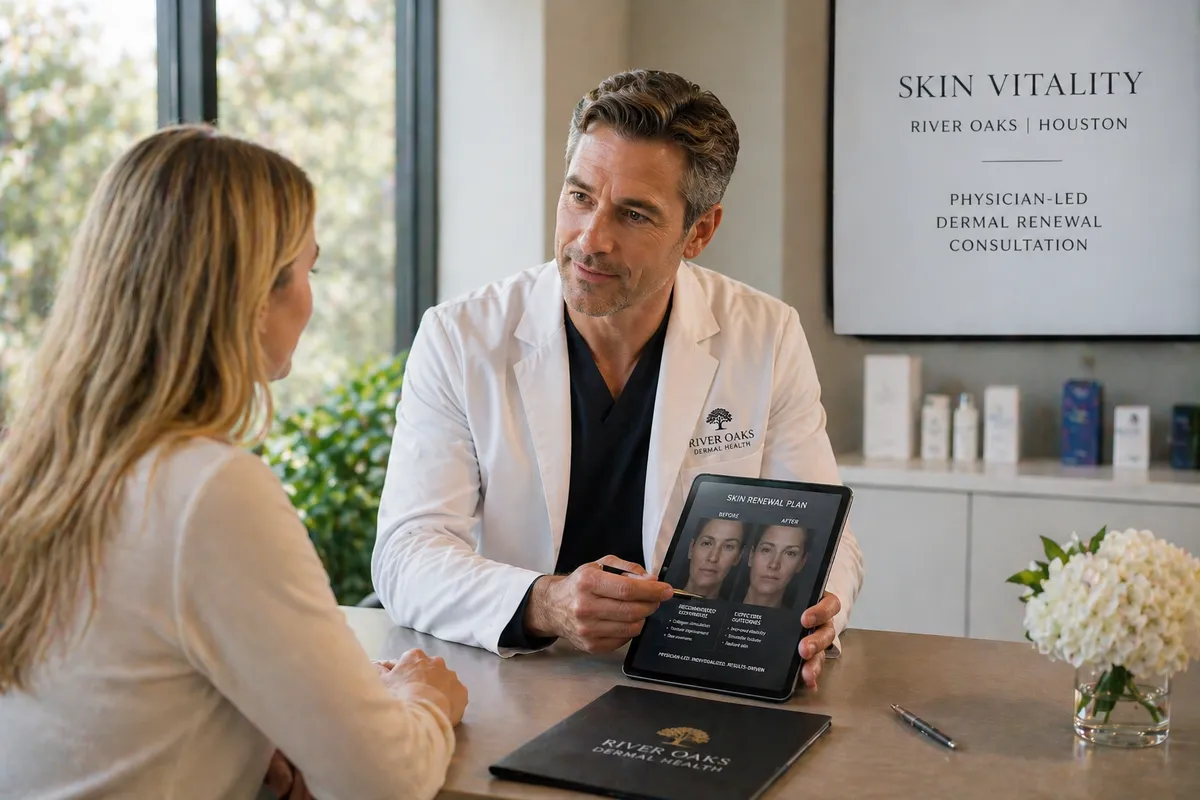
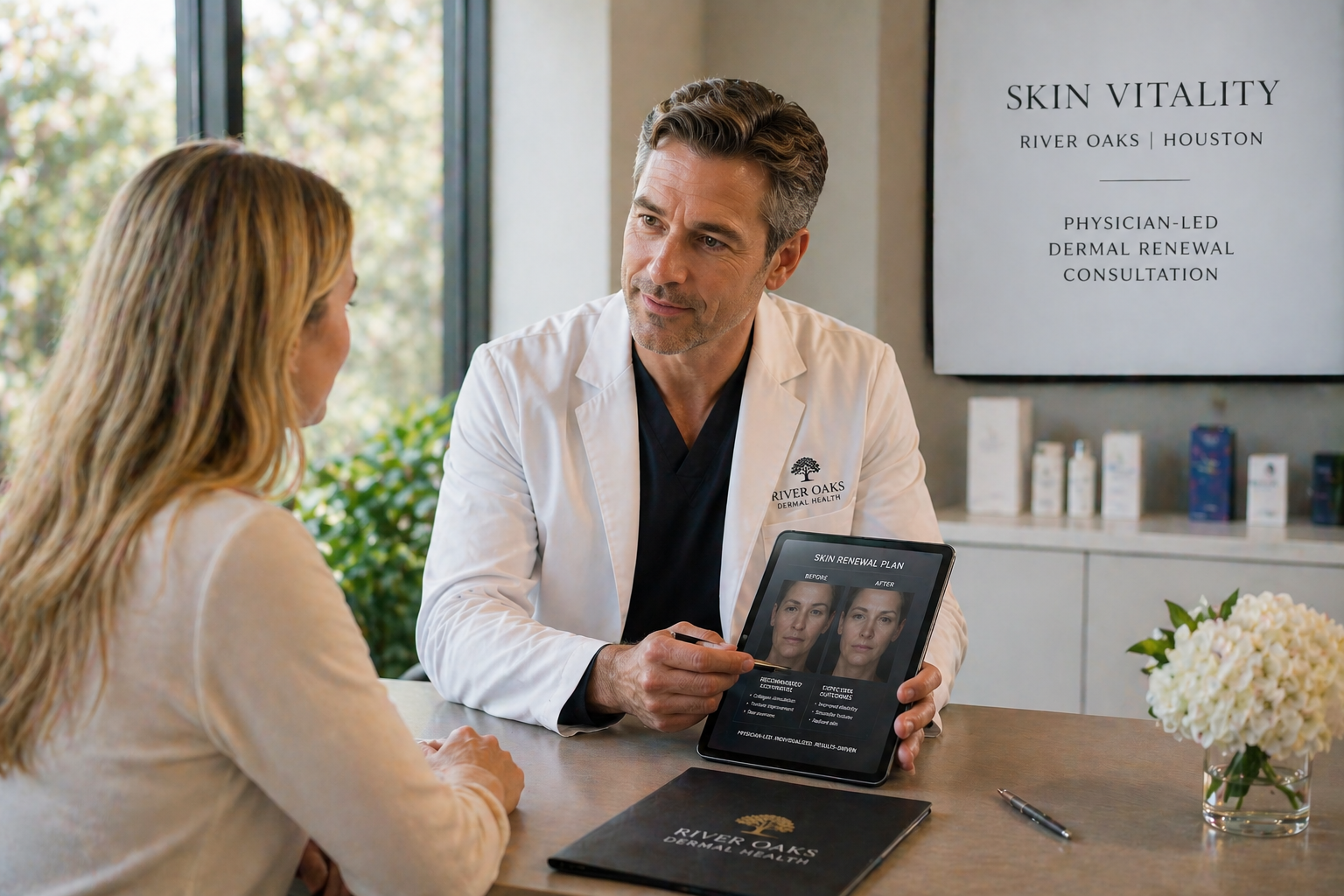
Addressing these changes well means connecting the treatment to the biology. It means asking which of these processes is the primary driver of what this specific person is seeing — and building a program designed to address it at the biological level rather than managing the surface alone. That is the physician-led approach. And it is why, in River Oaks, Houston, the approach matters as much as the treatment.
The Biology of Skin Aging — What Is Actually Happening
Collagen, Elastin, and the Structural Loss
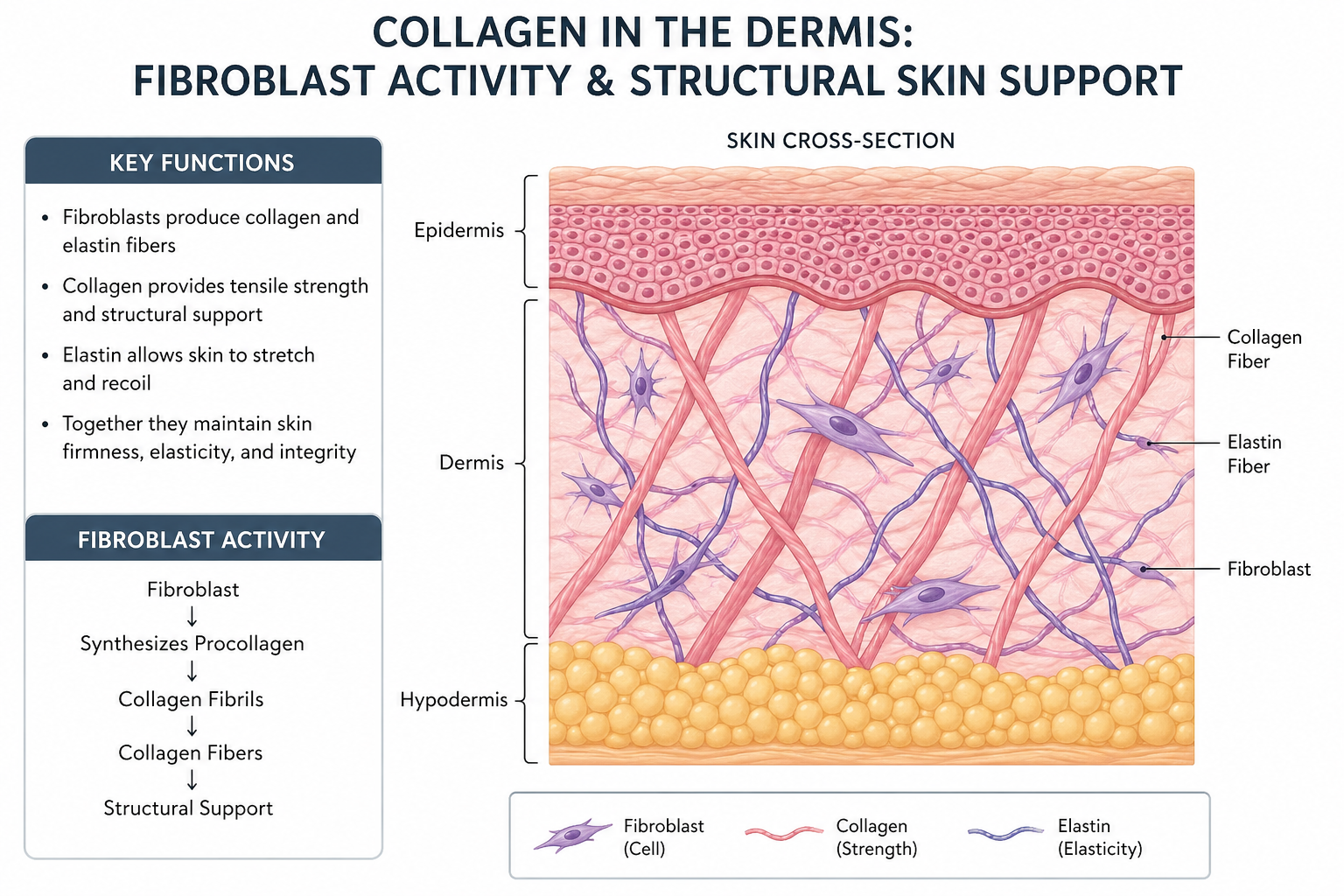
Collagen is the primary structural protein of the dermis — the scaffolding that gives skin its firmness, thickness, and resilience. Collagen production by dermal fibroblasts declines progressively beginning in the mid-20s, with the rate of decline accelerating through the hormonal transitions of midlife. By the time the patient notices meaningful changes in skin firmness and structural integrity, collagen decline has typically been compounding for twenty or more years.
Elastin — the protein responsible for the skin's ability to recover after deformation — undergoes its own distinct deterioration, with the additional characteristic that damaged elastin is poorly replaced in adult skin. The skin that loses elastin progressively loses not just firmness but the dynamic resilience that makes firmness functional. The structural changes visible in the mirror — the softening of contours, the settling of features, the loss of the springy quality that characterized younger skin — reflect this compounding biological loss.
Treatments that stimulate the skin's own collagen-producing fibroblasts are working at the level of this specific biological problem. Any change they support comes from the skin's own biological activity, which is why it develops gradually and tends to look natural. Results vary from person to person.
Cellular Renewal and Surface Quality
Young skin is in constant renewal — old cells shed and are continuously replaced by new ones in a cycle that maintains the surface in its best condition. This cycle slows progressively with age. Cells accumulate on the surface for longer before being shed. The result is a skin surface that looks less fresh, less even in tone and texture, and that reflects the accumulated presence of older, less metabolically active cells.
The pigmentation changes that develop with age — uneven tone, the spots that accumulate from years of sun exposure becoming more persistent — are amplified by the slowing of cellular renewal, because the mechanisms that would clear and remodel them operate more slowly. Treatments that support or accelerate cellular renewal address this biological process directly rather than addressing its surface expression alone.
The Hormonal Connection to Skin
Estrogen directly supports skin thickness, hydration, and the rate of collagen synthesis. The decline of estrogen through the hormonal transition of perimenopause and menopause produces accelerated changes in skin quality — a thinning, drying, and structural decline that is faster and more pronounced than the general age-related trajectory in many women. This is not incidental. It is a direct biological effect of the hormonal environment on the tissue.
Testosterone also influences skin quality in both men and women — affecting sebaceous function, skin thickness, and the overall biological vitality of the dermal environment. The patient who is addressing their hormonal health through the programs at valereregenerative.com/offerings/hormonal-health-vitality will often find visible improvement in skin quality as a downstream effect of hormonal optimization, because the biological conditions the hormonal program establishes support the skin's own maintenance and renewal processes.
Why the Physician-Led Approach Matters
The distinction between a physician-led skin program and an aesthetic treatment menu is not primarily a distinction about which procedures are available — it is a distinction about the clinical intelligence applied to the selection and sequencing of those procedures for a specific person's specific biology.
An aesthetic practice that begins with a menu applies treatments based on presenting concerns. A practice that begins with a clinical assessment applies treatments based on a clinical picture. The patient whose presenting concern is loss of firmness may be a candidate for collagen-stimulating biological approaches — exosome-based treatments, specific energy-based treatments, or a combination. Or the primary driver may be the hormonal environment, in which case addressing the skin without addressing the hormonal picture may be incomplete. The assessment distinguishes between these scenarios. The menu cannot.
The physician-led approach at Valere also means integration — the skin program is not a standalone service disconnected from the rest of the patient's clinical program. It is one dimension of the biological picture that the program holds in view simultaneously with the hormonal environment, the metabolic health, and the cellular support through IV therapy. The patient who is engaged across multiple dimensions of the Valere program will find that skin vitality benefits from the conditions that other program elements are creating — not just from the skin-specific treatments directly.
The skin vitality and dermal renewal program at valereregenerative.com/offerings/skin-vitality-dermal-renewal provides a complete overview of the program structure, the treatments available, and how the physician-led approach determines what is appropriate for each patient.
What Realistic Results Look Like — and How Long They Take
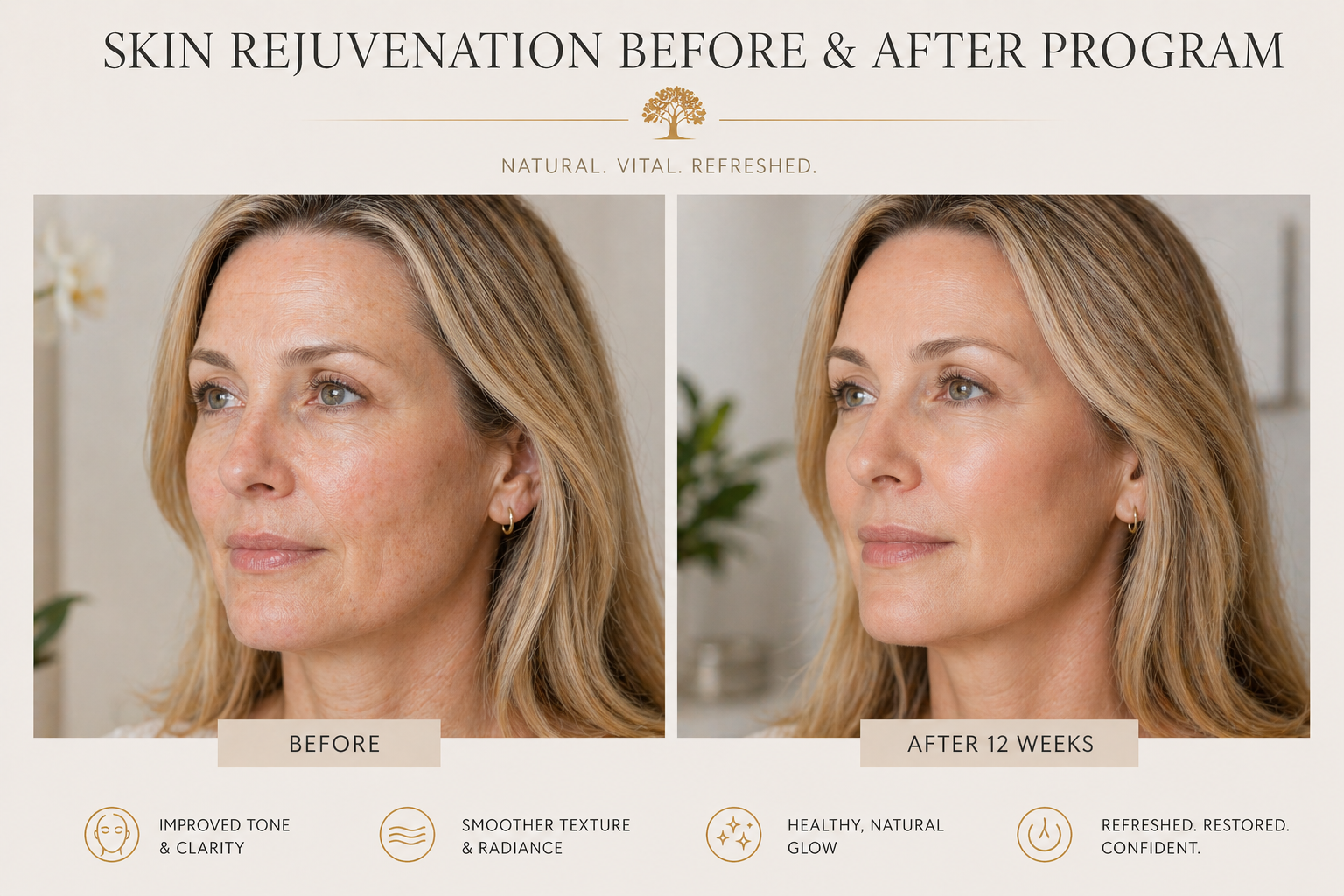
The aesthetic market has conditioned a set of expectations around visible skin improvement that the biological program approach does not conform to. Dramatic immediate results, transformation before-and-after, the kind of rapid visible change that characterizes injectable filler or post-surgical results — these are not the outcomes the regenerative approach produces, because it works by a fundamentally different mechanism.
Biological results develop on a biological timeline. Collagen remodeling is a slow process that unfolds over weeks to months, and any visible change tends to appear gradually rather than immediately. Your physician will set realistic expectations for your skin at the assessment.
The reason this timeline matters to the patient is that it is the honest timeline — and for the person who wants results that look like themselves, vital and maintained, rather than results that look like something was done, a gradual, biological approach is not a limitation. It is exactly what they were looking for.
Who the Skin Vitality Program Is For
The patients best suited to the skin vitality and dermal renewal program at Valere are adults between 45 and 70 who have noticed meaningful changes in skin quality and who want to address them with clinical seriousness — with a program that connects what they see to the biology producing it, that is built from an honest assessment of their specific situation, and that delivers results that reflect the precision and quality that the patient applies to everything else.
They are not looking for a dramatic aesthetic change that announces itself. They are looking for skin that reflects how they actually live — vital, maintained, precisely attended to. And they are looking for a practice capable of delivering that within a program framework that takes their whole biology seriously.
For questions about candidacy, process, and realistic expectations, the who we help page at valereregenerative.com/who-we-help and the FAQ at valereregenerative.com/faq provide direct answers. The starting point is the assessment at valereregenerative.com/assessment.
The Sequence of a Skin Vitality Program
A common question from the patient evaluating the skin vitality program at Valere is how a program is actually structured — not in the abstract but in the concrete sequence of what happens, in what order, over what period of time.
Every program begins with the assessment. The assessment establishes the specific skin concerns, the biological picture underlying them — the degree of collagen loss, the cellular renewal rate, the hormonal context, the photodamage picture — and the realistic outcomes a program can achieve for this specific patient's skin.
From the assessment, the program is sequenced. For many patients, the initial phase involves a series of treatments spaced to allow the biological response to each session to build before the next is delivered. The specific interval depends on the treatment approach and the clinical response. After the initial series, there is a period of biological consolidation — the four-to-six-week and then twelve-week evaluations at which the full response of the collagen and cellular renewal processes can be assessed.
Maintenance follows. The biological processes stimulated by the program are real tissue processes — they age, they require ongoing support to sustain what they have produced, and the maintenance interval is designed to provide that support efficiently without requiring the same investment as the initial program.
The skin vitality and dermal renewal program at valereregenerative.com/offerings/skin-vitality-dermal-renewal outlines the specific structure. The assessment at valereregenerative.com/assessment is where the program is made specific to you.
A Skin Program Connected to the Rest of Your Health
The patient who approaches skin vitality as one dimension of a comprehensive health program — connected to the hormonal, metabolic, and cellular dimensions that the rest of the Valere program addresses — produces outcomes that a standalone aesthetic treatment cannot achieve. This is not a philosophical preference. It is a biological reality.
The estrogen that supports collagen synthesis is the same estrogen that the hormonal program is optimizing. The cellular environment that the IV therapy program supports is the same cellular environment in which the skin's biological renewal processes operate. The metabolic conditions that the metabolic program is improving are reflected in the skin's inflammatory picture and vascular support.
When these conditions are addressed simultaneously through an integrated program, the skin vitality outcomes are supported from multiple biological directions at once. The physician-led approach holds all of these connections in view and builds the program that leverages them. The assessment at valereregenerative.com/assessment is where your specific biological picture is established and your specific program is designed. The physician-led approach does not treat the skin in isolation from this picture. It addresses the skin as part of the whole biology — which is precisely why the outcomes look different from what standalone aesthetic treatments produce, and why they are sustained in ways that isolated procedures rarely are.
Medical disclaimer: This article is for general education only and is not medical advice. Reading it does not create a doctor–patient relationship. The treatments discussed are not right for everyone, individual results vary and are not guaranteed, and some therapies mentioned may be used off-label or are not FDA-approved for the uses described. Please talk with a licensed physician about your own health before starting any treatment.