Pickleball Injuries in Houston: What to Do When Rest Is Not Enough
Pickleball Injuries in Houston: What to Do When Rest Is Not Enough
Medical oversight: Micah Craig, MD, Medical Director, Valere Regenerative
Pickleball has become one of the defining sport stories among adults between 50 and 75 in Houston over the past several years. The appeal is genuine — the sport is accessible, social, and provides the kind of competitive, physically engaging activity that this demographic has been looking for as other sports become more demanding on aging joints. The injury picture that has followed the sport's rise is now equally clear.
The knee, the elbow, and the shoulder bear the primary load of pickleball — and they do so in a population that is often playing three, four, or five times a week with the enthusiasm of a newly discovered passion. The rapid directional changes, the overhead reach, the repetitive lateral loading — all of it accumulates in biology that has less repair capacity and recovery speed than it had twenty years ago.
Rest, which is the standard initial clinical advice, addresses the acute picture. It reduces the inflammatory load. It allows the most inflamed tissue to quiet down. What it does not do is address the biological condition of the tissue that is producing the symptoms — and that condition does not resolve with rest alone. The patient who has already tried rest and found it insufficient deserves a clearer picture of what the options are.
The Three Pickleball Injuries That Bring Patients to Valere
Pickleball Knee
Pickleball demands rapid direction changes executed from an athletic crouched position — the ready position that good pickleball technique requires. This position places significant and repetitive load on the medial and patellofemoral compartments of the knee. The patient who plays three to five times per week accumulates that load at a rate that the knee's biological repair processes, already declining with age, cannot fully manage.
The result is the same degenerative picture that golf and tennis produce in the knee, but potentially accelerating faster given the frequency of play that pickleball enthusiasm tends to produce. Pain during play that becomes pain after play that becomes pain at rest. Stiffness that makes the morning after a hard match a recovery exercise. A knee that is progressively defining the limits of the game.
Pickleball Elbow
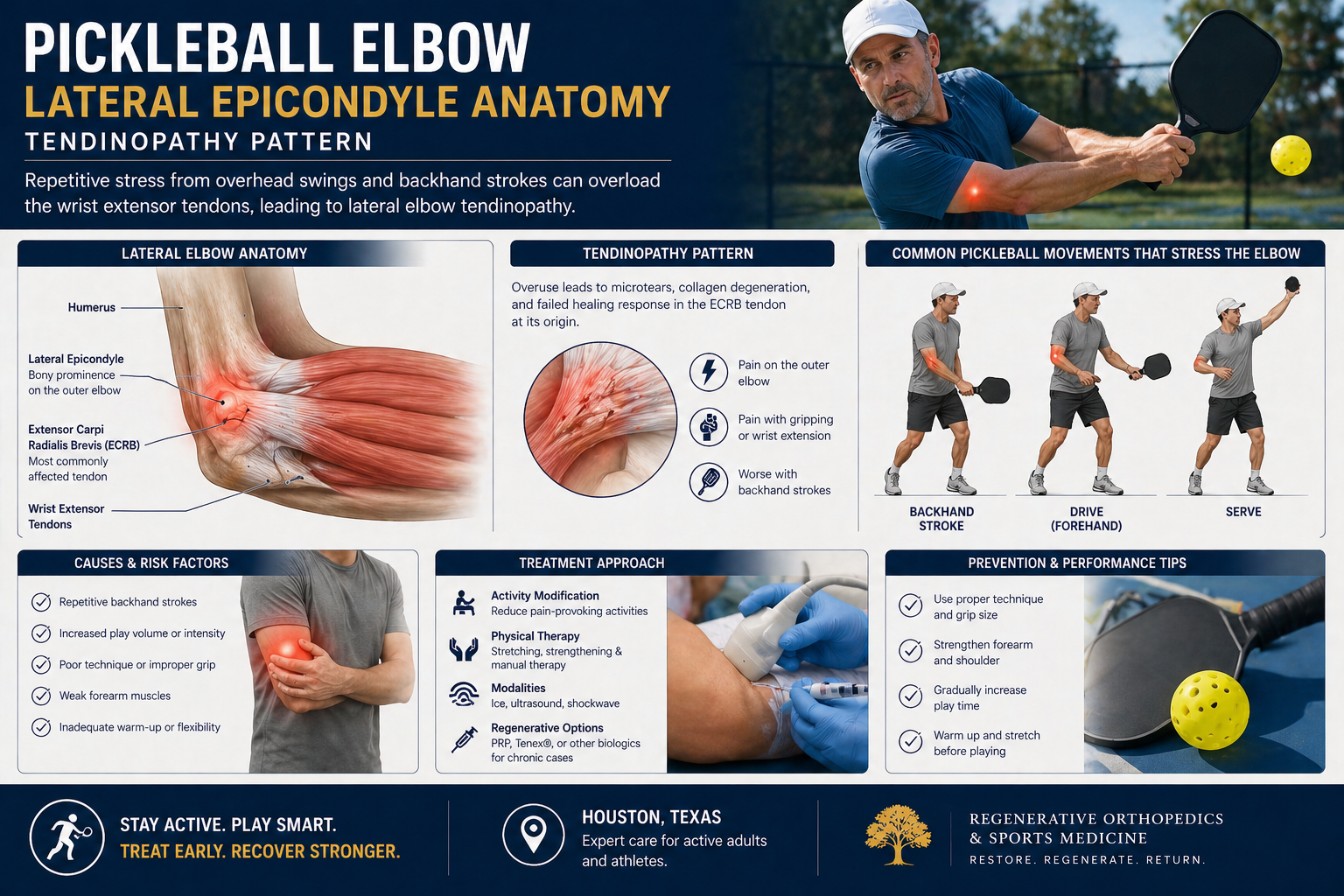
Lateral epicondylitis — the common extensor origin tendinopathy that most people call tennis elbow — has emerged as one of the most consistent injuries in the pickleball-playing population. The mechanics of the pickleball backhand place torsional load on the lateral elbow that produces the same degenerative tendinopathy pattern as tennis elbow, but in a population often playing more frequently than recreational tennis players.
The critical clinical distinction is that this injury is tendinopathy — a biological failure of the tendon maintenance process — rather than an acute strain or tear. Rest may reduce the acute inflammatory picture, but tendinopathy is a chronic degenerative condition that does not resolve with rest alone. For some people, rest alone is not enough. Understanding this distinction is the starting point for understanding why a regenerative approach may be worth evaluating.
Pickleball Shoulder
The overhead demands of pickleball — the drive, the lob, the overhead smash at the net — place rotator cuff loading on shoulders that are often already carrying the accumulated load of years of previous athletic activity. For the patient who played tennis for twenty years before discovering pickleball, the shoulder is encountering new overhead demand on tissue that was already operating with reduced biological reserve.
The result is rotator cuff tendinopathy that develops faster and with more intensity than it might in a younger shoulder with more biological resilience — and that requires a clinical approach calibrated to the actual tissue biology rather than one built around the assumption that rest and time will resolve it.
What a Regenerative Program for Pickleball Injuries Involves
The program for pickleball injuries at Valere follows the same clinical structure as all joint programs: assessment first, program built from the clinical picture, intervention delivered with precision and image guidance, monitoring and adjustment built into the program from the beginning.
For the knee, elbow, or shoulder affected by pickleball, the program typically centers on exosome therapy delivered under ultrasound guidance to the specific structures that the assessment identifies as the primary drivers of the symptoms, often paired with StemWave. Exosomes carry signaling molecules involved in the body's own repair processes; how much a given joint or tendon responds varies from person to person. Exosome therapy for orthopedic cases typically starts at $2,250, depending on the case.
The precision of image-guided delivery matters for all three of these injury sites. The knee joint, the common extensor origin at the lateral epicondyle, and the rotator cuff tendons are all small, specific anatomical targets where the difference between accurate placement and approximate placement is a matter of clinical precision. At Valere, image guidance is not an upgrade — it is the clinical standard.
The program also manages the return to play as a structured clinical process rather than a binary decision. The patient does not simply wait until the pain is gone and return at full intensity. They follow a loading progression that supports the tissue environment as it recovers, with milestones that confirm the biological response before the demand is increased. This is part of what distinguishes a program from a single treatment.
The joint renewal and mobility program at valereregenerative.com/offerings/joint-renewal-mobility-longevity provides a complete overview of how the approach works across joint sites. The starting point is the assessment at valereregenerative.com/assessment.
The Prevention Conversation
The patient who has completed a regenerative program for a pickleball injury is often interested in what a maintenance approach looks like. Having felt what happens when load outpaces recovery, they understand that prevention is not simply playing less.
Maintenance at Valere involves monitoring the joint environment at defined intervals and intervening — with a maintenance exosome protocol or other biological support — before the accumulated demand produces another symptomatic episode. This is the program model applied to the most common situation that active patients face: not just addressing the injury that brought them in, but building the biological resilience to stay in the game they have built their life around.
If you are dealing with a pickleball injury that rest has not resolved and you want to find out what the right clinical approach looks like, reserve your assessment at valereregenerative.com/assessment.
A Note on the Frequency of Play
One of the consistent contributors to the pickleball injury pattern is the frequency with which the patient plays. Golf played four times a week and tennis played four times a week are not the norm among recreational players. Pickleball played four or five times a week is relatively common — particularly among newly converted enthusiasts who have found in the sport a social and competitive outlet they want to maximize.
The biological reality is that more frequent play means more accumulated load on tissue that has less biological reserve for repair and recovery than it had twenty years ago. A maintenance approach that monitors the joint environment and provides biological support before symptoms recur is a more sustainable strategy than treating each recurrence as a new episode. That conversation is part of what the assessment at valereregenerative.com/assessment opens.
Medical disclaimer: This article is for general education only and is not medical advice. Reading it does not create a doctor–patient relationship. The treatments discussed are not right for everyone, individual results vary and are not guaranteed, and some therapies mentioned may be used off-label or are not FDA-approved for the uses described. Please talk with a licensed physician about your own health before starting any treatment.