
Metabolic Health in River Oaks: Why Your Labs Look Normal but You Still Do Not Feel Like Yourself
Metabolic Health in River Oaks: Why Your Labs Look Normal but You Still Do Not Feel Like Yourself
Medical oversight: Micah Craig, MD, Medical Director, Valere Regenerative
The annual physical results arrive, and the physician's summary is reassuring. Cholesterol panel is within acceptable range. Fasting glucose is fine — not flagged, not concerning. The thyroid marker was included and is normal. There is nothing alarming in the results, the physician review is brief and positive, and the conversation moves on.
But you know — with the clarity of someone who has paid precise attention to their own biology for decades and who has operated at a demanding level long enough to recognize when something has genuinely shifted — that something has. The energy is qualitatively different. The body composition is changing in ways that resist the same approach that maintained it reliably for twenty years. Recovery from training is slower and requires more. The afternoon cognitive slowdown is more pronounced and harder to override. Sleep technically happens but the morning does not feel like it did.
You are not imagining it. And the lab results are not lying. Both things are true simultaneously — and understanding why requires a clinical conversation that the standard annual physical was not designed to have with you.

What the Standard Metabolic Panel Was Built to Find
The standard metabolic panel — fasting glucose, HbA1c, basic lipid fractions, liver function markers, kidney function markers — was designed around a specific and important clinical objective: identifying pathology. Diabetes. Pre-diabetes. Dyslipidemia that elevates cardiovascular risk. Organ dysfunction that requires clinical attention. The panel is built to catch conditions defined by crossing a threshold of clinical significance.
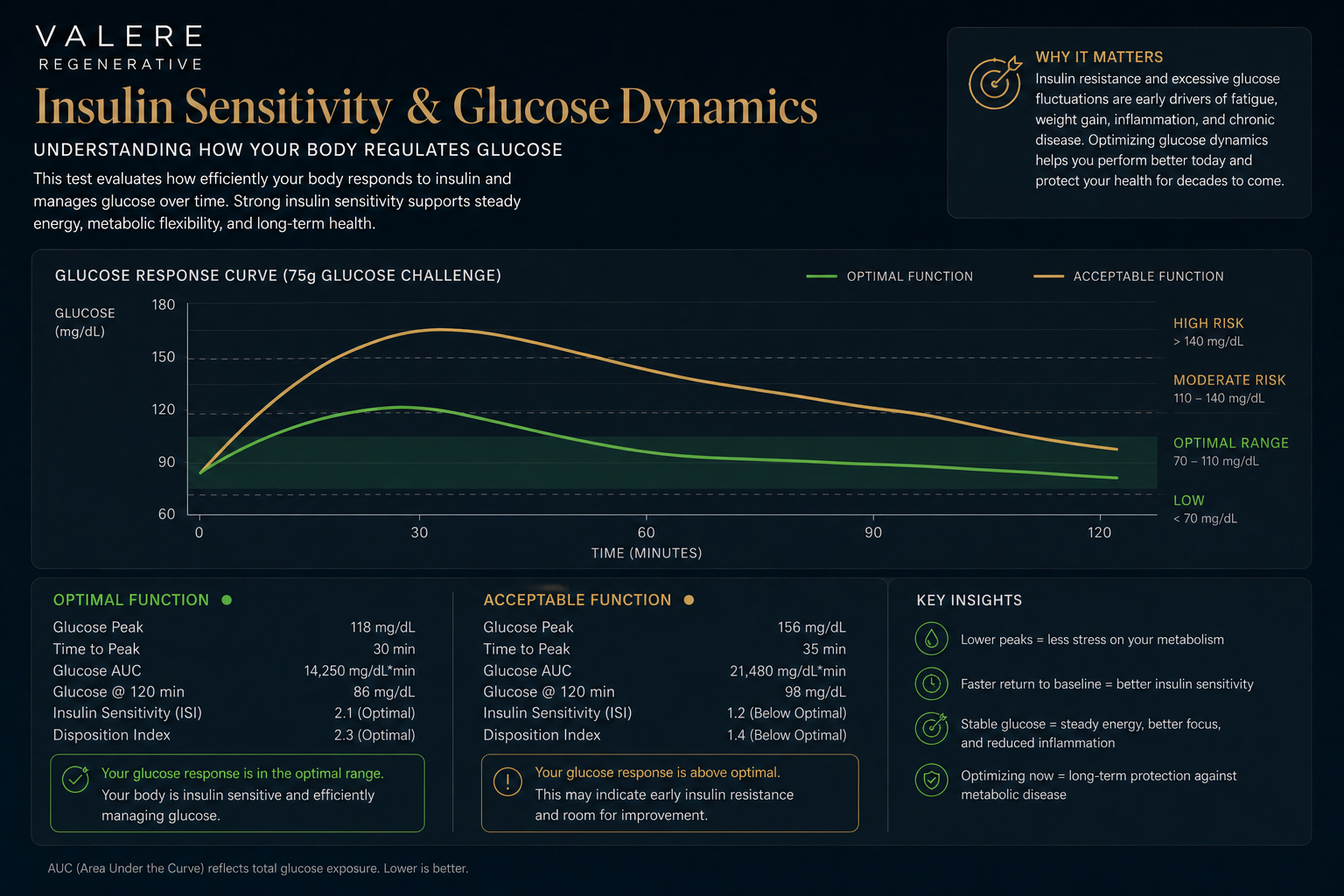
What it is not built to identify is the metabolic environment in which a specific person functions at their highest level. Glucose dynamics outside the diabetic range but trending in a direction that affects energy and cognitive function. Insulin sensitivity that is technically adequate but meaningfully reduced from where it was five years ago. An inflammatory picture that is not alarming but is not optimal. Mitochondrial and cellular energy dynamics that underlie the subjective experience of diminished biological reserve. These variables determine how the patient experiences their biology day to day — and they exist entirely within the normal ranges that the standard panel evaluates.
A fasting glucose of 96 does not trigger a clinical flag. For a patient who was operating at 82 five years ago, the trajectory from 82 to 96 represents a meaningful shift in insulin sensitivity and glucose regulation — one that affects energy availability, fat partitioning, inflammatory tone, and cognitive function in ways that are clinically relevant and that are directly addressable with the right program. The standard panel will not capture this significance. The physician who sees a normal result and moves on is operating correctly within the framework they are using. The framework is not designed for this conversation.
What Suboptimal Metabolic Function Feels Like from the Inside
The patient with a suboptimal metabolic picture rarely presents with a single definitive symptom. They present with a constellation of experiences that seem individually explainable — stress, workload, age, a particularly demanding season — until the metabolic connection becomes apparent.
Energy that was once reliable and abundant becomes variable and requires management. The afternoon period that used to be productive requires increasing effort or caffeine support. The morning energy that used to arrive naturally requires more time to access. The drive that powered a high-performance career becomes less reliable as a consistent internal resource.
Body composition shifts despite no meaningful change in the approach that produced and maintained the patient's physical condition. Fat accumulates differently — particularly in the midsection in men, in broader distribution in women going through the hormonal transition. Muscle maintenance becomes harder. The body composition responds less predictably to training and dietary management than it did before, and the usual interventions produce less reliable results.
Cognitive changes accompany the metabolic picture. Processing speed, verbal recall, the ability to engage sustained concentration across a long professional day — these are directly influenced by the metabolic environment, specifically by glucose dynamics and the quality of cellular energy production. The patient who notices that their sharpest mental tool is not as consistently available as it was is often noticing a metabolic effect.
What the Metabolic Program at Valere Addresses
The metabolic health program at Valere begins with an assessment that evaluates the metabolic picture with the depth that optimization requires. This goes beyond the standard panel: insulin sensitivity and fasting insulin, advanced inflammatory markers including high-sensitivity CRP, detailed thyroid evaluation beyond the standard TSH, advanced lipid fractionation that provides cardiovascular risk information the basic panel misses, hormonal markers that contribute to the metabolic picture, and the other components that together describe what the metabolism is actually doing.
From that picture, a program is built. The program is specific to the patient and specific to what the assessment shows. It may address the dietary patterns that are affecting insulin dynamics — not with generic nutritional advice but with specific recommendations anchored in the actual metabolic picture. It may address the hormonal variables that are driving the body composition changes, through the hormonal programs that Valere offers. It may include cellular support through IV therapy that addresses the mitochondrial environment. It includes monitoring that tracks how the metabolic variables are responding to the program and adjustment when the picture calls for it.
For men, the metabolic health and body composition program is shaped by the specific metabolic patterns that affect male biology — the testosterone-insulin sensitivity relationship, the lean mass dynamics, the cardiovascular risk picture that intersects with the metabolic picture. The details are at valereregenerative.com/offerings/metabolic-health-body-composition/mens-metabolic-health.
For women, the metabolic picture is significantly shaped by the hormonal transition — the shift in estrogen that changes insulin sensitivity, fat distribution, and body composition in ways that the metabolic program at valereregenerative.com/offerings/metabolic-health-body-composition/womens-metabolic-health addresses with the clinical specificity it requires.
The Body Composition Connection
The patient who has noticed that their body is responding differently to the same inputs — that fat is accumulating despite the same training load and dietary discipline that maintained the body composition they are used to — is almost always experiencing a metabolic picture that is the primary driver of those changes.
This matters clinically because it changes the intervention. Approaching body composition as a metabolic problem — evaluating the insulin dynamics, the hormonal environment, the inflammatory picture, and the mitochondrial function that together determine how the body partitions fuel — produces more targeted and more sustainable improvement than treating it as a simple energy balance problem that more restriction and more training should solve.
The program orientation holds the metabolic picture and the body composition goal in view simultaneously — building toward both, monitoring both, and adjusting based on how the two are responding. The result is a biological environment in which the patient's body begins responding again to the approach they are putting into it.
If you recognize this pattern — results that are technically normal, a body and a felt experience that are telling a different story — the metabolic health program at Valere is worth a direct conversation. Reserve your assessment at valereregenerative.com/assessment and find out what your metabolism is actually doing and what a program designed around it can accomplish.
Medical disclaimer: This article is for general education only and is not medical advice. Reading it does not create a doctor–patient relationship. The treatments discussed are not right for everyone, individual results vary and are not guaranteed, and some therapies mentioned may be used off-label or are not FDA-approved for the uses described. Please talk with a licensed physician about your own health before starting any treatment.