
Menopause, Energy, and Performance: What Houston Women Need to Know About Hormonal Optimization
Menopause, Energy, and Performance: What Houston Women Need to Know About Hormonal Optimization
Medical oversight: Micah Craig, MD, Medical Director, Valere Regenerative
The conversation around menopause has improved meaningfully over the past decade. The era of dismissing symptoms as inevitable changes to be accepted quietly, or as problems that belong to a lesser clinical priority, is receding. Research has advanced. Clinical frameworks have evolved. And the women who experienced the full weight of the hormonal transition twenty years ago and were told to cope are watching their peers access a genuinely different level of clinical seriousness.
But improvement is not sufficient. The high-performing woman in Houston who is navigating perimenopause or menopause while maintaining a demanding professional life, an active physical life, and a social and family life that requires her to be present and capable at the highest level — she needs more than better awareness and more sympathetic practitioners. She needs a clinical program built around her specific hormonal picture, designed to preserve the performance, clarity, energy, and physical capacity she has built and intends to maintain.
The Biology of the Hormonal Transition
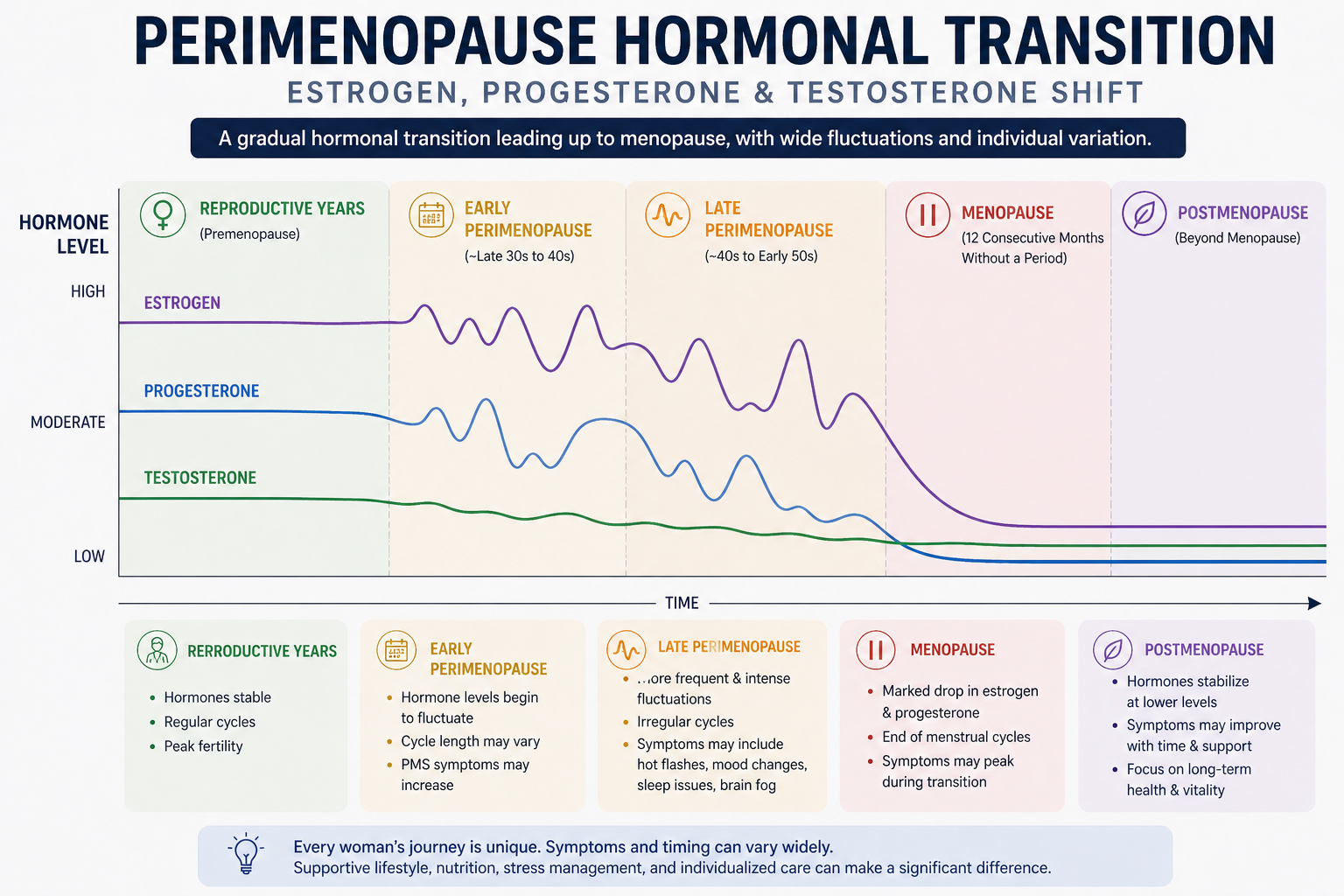
The hormonal transition of perimenopause and menopause is not a single moment or a simple decline. It is a multi-year process — often spanning a decade or more when the full perimenopause arc is included — during which estrogen, progesterone, and testosterone shift in ways that are individually variable, sometimes erratic in the perimenopause phase, and biologically consequential across multiple body systems simultaneously.
Estrogen influences a remarkable range of systems: sleep architecture, mood regulation, cardiovascular function, bone density, cognitive function including verbal memory and processing speed, skin quality and collagen synthesis, and the metabolic environment including insulin sensitivity and fat partitioning. When estrogen levels become irregular and then decline, these systems are affected — not all at once, not in the same sequence in every woman, but progressively and meaningfully.
Progesterone plays a distinct and important role — particularly in sleep quality, anxiety regulation, and the balance of the reproductive hormonal axis during the perimenopausal transition. Progesterone decline can precede estrogen decline, and the relative ratio of the two hormones matters as much as the absolute levels.

Testosterone, which declines in women as well as men — from a lower absolute level but with effects that are directly relevant to energy, libido, muscle maintenance, cognitive function, and confidence — is frequently underaddressed in the clinical conversation about women's hormonal health. The focus on estrogen and progesterone has historically left testosterone underrepresented in the program design, and whether it belongs in a woman's program is a question worth asking her physician.
Why the Timing of Intervention Is a Clinically Important Question
Research on hormone therapy suggests that timing relative to the menopausal transition matters, both for the range of options available and for the balance of risks and benefits a physician will weigh. That is one reason the conversation is worth having earlier rather than later.
This is not intended to create unnecessary urgency. It is a clinical reality that the patient woman deserves to understand clearly as part of making an informed decision about when to begin the conversation. The woman who addresses this in perimenopause, with strong baseline biology and a full range of program options available, has different clinical conditions than the one who waits a decade. Either may be a candidate for a well-designed hormonal program. The starting conditions differ.
The women's hormonal health program at valereregenerative.com/offerings/hormonal-health-vitality/womens-hormonal-health outlines the Valere approach to the hormonal transition at different stages and what the program involves.
What a Program Aims For
The patient woman who completes a well-designed, monitored hormonal optimization program — one that is built from her specific hormonal picture and adjusted over time as the picture evolves — is typically working toward a connected set of goals: better sleep, steadier mood, more reliable energy, body composition that responds to a reasonable approach, and clearer thinking.
Sexual health and comfort are often part of that conversation as well, and many women do not connect these changes to their hormonal picture until a physician raises it.
These are goals, not guarantees, and hormone therapy is not right for every woman. They depend on the specific clinical picture, the stage of the transition, the program design, and the quality of the ongoing monitoring and adjustment. Whether they are realistic for you, and whether the benefits outweigh the risks in your case, is what the assessment is designed to determine.
A Practice That Takes This Seriously
The patient woman who has raised these concerns with a physician who reviewed her labs, found them within range for her age, and moved on knows precisely what the experience of being underserved feels like. She is not looking to repeat it.
She is looking for a practice that treats women's hormonal health as a discipline requiring the same clinical rigor, program orientation, and commitment to monitoring and adjustment that any other serious dimension of health demands. That is what Valere provides — not as a marketing claim but as the structural commitment of a physician-led practice built around the people it serves.
The FAQ at valereregenerative.com/faq answers the questions most women ask before beginning a hormonal program. The starting point, when you are ready, is the assessment at valereregenerative.com/assessment.
The Woman Who Has Been Told to Cope
There is a specific subset of the patient women who come to Valere who have had their concerns reviewed and their labs evaluated and have been told that what they are experiencing is normal for their age and that the best approach is to manage the symptoms as they arise. This experience is not uncommon. It is not acceptable for the patient who has maintained exceptional standards across every other dimension of her life and who expects her health to receive the same quality of attention.
Coping with the hormonal transition is not a clinical strategy. It is the absence of one. The woman who has been offered coping instead of optimization deserves to know that the optimization option exists — that a physician-led, program-oriented approach to her hormonal picture is available, is clinically grounded, and produces outcomes that are meaningfully different from management alone.
That is what Valere provides. The starting point is the assessment at valereregenerative.com/assessment — a genuine clinical evaluation of the hormonal picture and an honest conversation about what a program built from it can accomplish.
The patient woman who decides not to wait — who brings the same proactive, structured approach to her hormonal health that she has applied to every other significant dimension of her life — will find at Valere the clinical partner who was built for exactly that decision.
Medical disclaimer: This article is for general education only and is not medical advice. Reading it does not create a doctor–patient relationship. The treatments discussed are not right for everyone, individual results vary and are not guaranteed, and some therapies mentioned may be used off-label or are not FDA-approved for the uses described. Please talk with a licensed physician about your own health before starting any treatment.