
Low Testosterone in Houston: Why So Many Men Are Getting the Wrong Answer from Routine Medicine
Low Testosterone in Houston: Why So Many Men Are Getting the Wrong Answer from Routine Medicine
Medical oversight: Micah Craig, MD, Medical Director, Valere Regenerative
You are not someone who complains about your health. You have built things, run things, maintained high performance standards across a career that has demanded a great deal. When you began noticing that your energy was different — not dramatically depleted but qualitatively changed, requiring more effort for the same output — you managed it. When your body composition began shifting in ways that resisted the approach that had maintained it for twenty years, you trained harder. When the cognitive edge that has served your career began to feel fractionally less consistent, you attributed it to workload.
And then you got labs done. The testosterone result came back within the normal range. The physician reviewed the numbers, found nothing alarming, and moved on. You left with no actionable answers and the same symptoms you came in with.
This experience is among the most common clinical stories that men in their 40s, 50s, and 60s in Houston bring to Valere. It reflects a specific and important gap between what routine medicine can identify and what the patient who is experiencing the effects of declining testosterone actually needs.

The Reference Range Problem in Detail
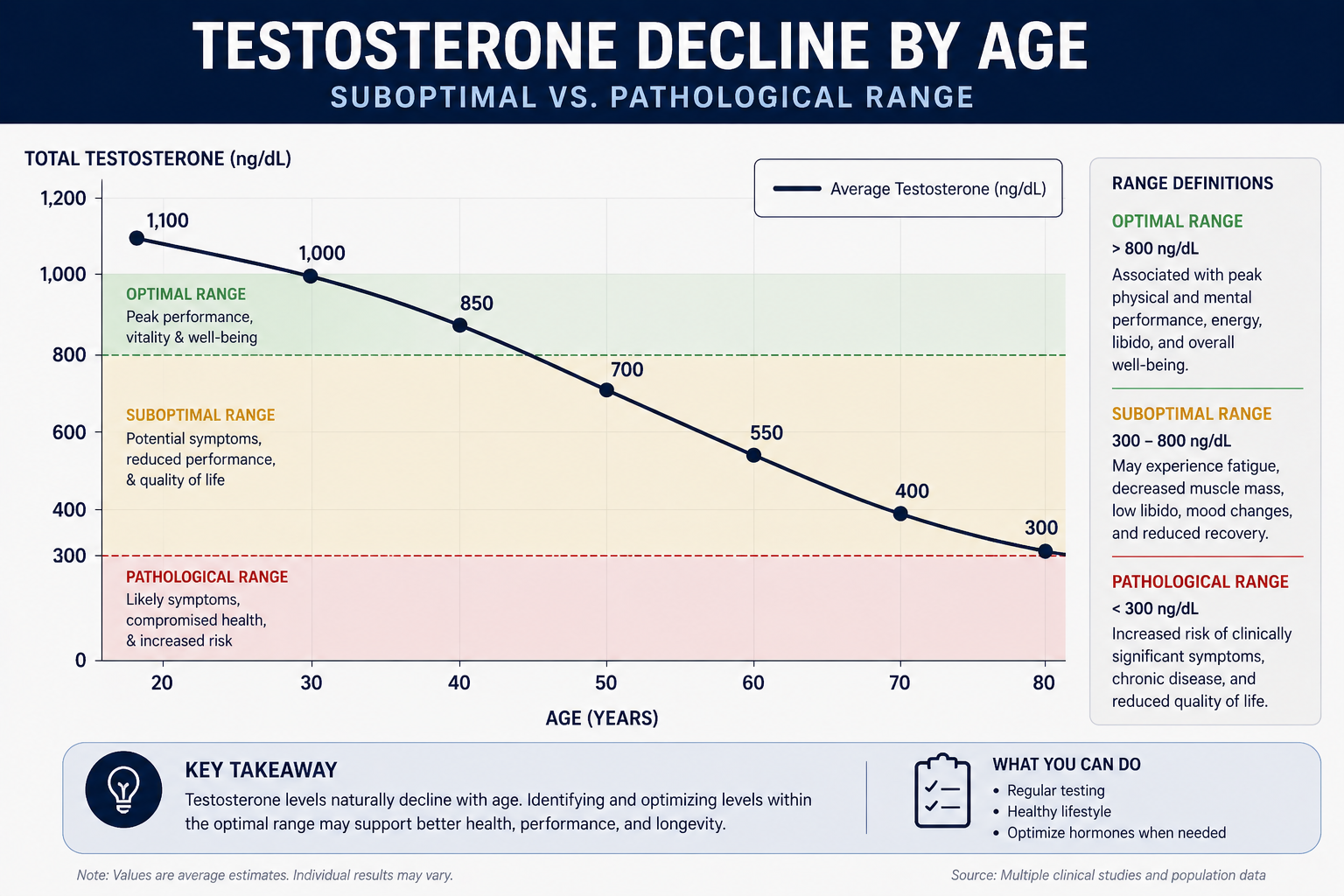
The normal range for testosterone on a standard lab panel is constructed from population-level data — the distribution of testosterone values across a large sample of men of varying ages, health statuses, and biological profiles. A result within this range means the value is not in the lowest fraction of the population distribution. It does not mean the level is optimal for you, or that it is supporting your energy, body composition, cognition, and sexual health at the level your biology is capable of.
The range was designed to identify clinical hypogonadism — a condition of significant hormonal deficiency with specific diagnostic criteria. It was not designed to identify whether the hormonal environment of this specific person supports their highest level of function. These are different questions, and the reference range answers only the first one.
A man whose free testosterone is at the 12th percentile of the reference range is within normal limits. He is also experiencing the energy, mood, cognitive, libido, and body composition effects that are consistent with that level — and those effects are meaningfully different from what he experienced when his testosterone was at the 55th or 60th percentile of the same range. The lab cannot capture this difference. The physician who reviews the normal result and moves on is not making an error within the framework they are operating in. The framework is the problem — it was built for a different purpose.
What Suboptimal Testosterone Actually Affects in Practice
The effects of testosterone that is present but suboptimal for the individual man extend across multiple systems simultaneously — and the patient often does not connect the various changes to a common hormonal origin because they arrive individually, gradually, and without a single clear moment of onset.
Energy and drive are typically the most prominent. The internal motivation that characterized the patient's professional life — the capacity for sustained effort, for engaging with difficult problems, for the kind of forward-leaning energy that built what he has built — becomes less reliable. Not absent. Present but requiring more work to access. The effort that used to feel natural starts to feel like effort.
Muscle maintenance becomes harder and fat accumulation easier, particularly in the midsection. The body responds differently to the same training load and the same dietary approach that produced and maintained the patient's physical condition for years. The changes are real, they resist the usual interventions, and they are frequently attributed to aging without ever being evaluated as potentially hormonal in origin.
Cognitive changes follow a similar pattern — not dramatic decline but a fractional reduction in processing speed, verbal recall, and the mental sharpness that the patient has relied on and defined himself by. Sleep quality deteriorates. Mood becomes less stable, with a narrowed emotional range that affects relationships and self-perception. Libido and sexual performance change in ways that affect confidence and the intimate dimension of the patient's life.
These are not separate problems requiring separate management. They are downstream effects of a shared hormonal environment — and addressing the environment addresses all of them more effectively than managing each symptom individually.
What the Right Approach Looks Like
The Valere approach to men's testosterone optimization begins with a comprehensive assessment that evaluates the full hormonal picture — not the headline total testosterone but the complete relevant picture: free and total testosterone, SHBG, estradiol, LH, FSH, DHEA-S, thyroid function, and the metabolic markers that provide context for what the hormonal numbers mean in this specific man.
The panel is evaluated in the context of the clinical consultation — the patient's symptoms, their functional experience, their history, their goals. The target is not a population reference range. The target is the hormonal environment in which this specific person functions at his best — and the program is built to establish and maintain it.
Delivery method, dosing, and monitoring frequency are individualized. The program involves regular evaluation of the hormonal response, adjustment as the biology evolves, and clinical attention to the downstream effects — red blood cell parameters, cardiovascular markers, prostate health — that testosterone optimization appropriately requires monitoring. This is a program, not a prescription followed by a six-month check-in.
The details are at valereregenerative.com/offerings/hormonal-health-vitality/mens-hormonal-health. The starting point is the assessment at valereregenerative.com/assessment. The patient who addresses this while his baseline biology is still strong has better conditions for optimization than the one who waits. That is not a sales message. It is a clinical reality.
The Patient Who Waits
There is a specific clinical reality worth stating directly for the patient who is reading this and recognizing his own experience but is not certain the evidence is sufficient to warrant a serious clinical evaluation. The hormonal decline that begins in earnest in the 40s and continues through the 50s and 60s is progressive. The starting conditions for optimization — the baseline biological health, the tissue quality, the metabolic environment, the cardiovascular picture — are better earlier than later.
This is not a sales urgency claim. It is a straightforward biological reality: the patient who evaluates and optimizes his hormonal health at 52 is starting from different conditions than the one who waits until 62. Either may be a candidate for a well-designed program, but earlier evaluation gives the physician more options to consider.
If you have been carrying the suspicion that your experience of your own biology does not match what normal means to you — and you have been carrying it for more than a year without a serious clinical evaluation — the assessment at valereregenerative.com/assessment is the appropriate next step. Not next year. Now.
The assessment is not a commitment to a program. It is a clinical evaluation that produces an honest picture of where your hormonal environment is and what a program designed around it can accomplish. For the patient who has been carrying this question for a year or longer, the assessment is the appropriate and overdue next step. Begin with the assessment. Do not wait.
Medical disclaimer: This article is for general education only and is not medical advice. Reading it does not create a doctor–patient relationship. The treatments discussed are not right for everyone, individual results vary and are not guaranteed, and some therapies mentioned may be used off-label or are not FDA-approved for the uses described. Please talk with a licensed physician about your own health before starting any treatment.